




The Role of Accounting in the Rise of Impact Investing is increasingly crucial. Impact investing, a strategy that seeks to generate both financial returns and positive social or environmental impact, relies heavily on accurate and transparent accounting practices. This necessitates the development of new accounting frameworks and standards that go beyond traditional financial metrics to capture the multifaceted nature of impact. Understanding how accounting measures, reports, and mitigates risk within impact investments is key to unlocking its full potential and attracting further investment.
This exploration delves into the challenges and innovations in impact accounting, examining its role in due diligence, risk assessment, and the overall growth of this burgeoning investment sector. We will analyze existing reporting frameworks, explore potential technological advancements, and consider the future implications of integrating environmental, social, and governance (ESG) factors into financial reporting for impact investments.
Defining Impact Investing and its Core Principles
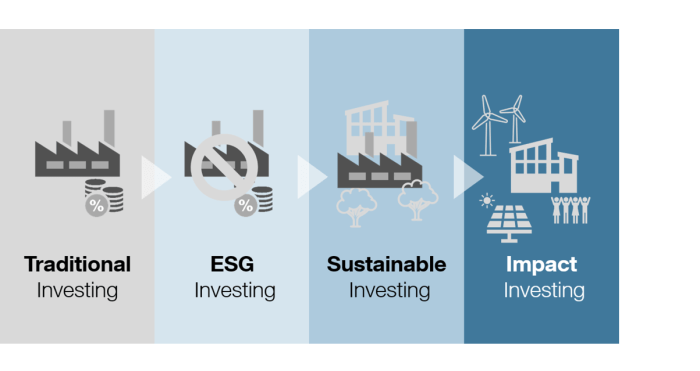
Impact investing represents a significant shift in the investment landscape, moving beyond purely financial returns to encompass measurable positive social and environmental impact alongside profit. Unlike traditional investing, which primarily focuses on maximizing financial returns, impact investing integrates a dual objective: generating financial returns while simultaneously achieving specific social or environmental goals. This approach seeks to address pressing global challenges while providing investors with attractive financial returns.
Impact investing distinguishes itself through its intentional pursuit of measurable social and environmental impact. It’s not simply about avoiding “harmful” investments; it’s actively seeking to generate positive change. This requires a rigorous approach to measuring and managing impact, which is a key differentiator from traditional investing strategies. The integration of impact measurement is central to the impact investing process, providing transparency and accountability.
Key Performance Indicators (KPIs) for Impact Measurement
Measuring the impact of investments requires a robust framework of KPIs. These metrics go beyond traditional financial indicators and delve into the specific social and environmental outcomes targeted by the investment. The selection of appropriate KPIs is crucial and depends heavily on the specific investment’s goals. For instance, a microfinance investment might track the number of loans disbursed to women entrepreneurs, while an investment in renewable energy might focus on the reduction in greenhouse gas emissions. A comprehensive approach often utilizes both quantitative and qualitative data.
- Quantitative KPIs: These are measurable numerical data points, such as the number of jobs created, tons of carbon emissions reduced, or increase in household income. For example, a company investing in affordable housing might track the number of affordable housing units built or the number of families housed.
- Qualitative KPIs: These are more descriptive and assess the impact through narratives, interviews, and case studies. For instance, an investment in a community development project might evaluate the improvement in community well-being through qualitative surveys and interviews with community members. This can assess improvements in health, education, or overall quality of life.
Impact Investing Strategies and Goals
Impact investing strategies vary widely depending on the desired impact and investment approach. Several common strategies exist, each with its unique goals.
- Microfinance: This strategy provides small loans and financial services to individuals and small businesses in developing countries, aiming to alleviate poverty and empower entrepreneurs. The primary KPIs might include the number of loans disbursed, loan repayment rates, and the increase in income levels of borrowers. For example, Kiva, a non-profit organization, facilitates microloans to entrepreneurs globally, contributing to economic development and poverty reduction.
- Renewable Energy: Investments in renewable energy sources like solar and wind power aim to reduce carbon emissions and promote sustainable energy solutions. Key KPIs might include the amount of renewable energy generated, the reduction in greenhouse gas emissions, and the creation of green jobs. Companies like NextEra Energy, a leading renewable energy company, demonstrate this strategy, reducing carbon footprint and generating clean energy.
- Affordable Housing: This involves investing in the development and provision of affordable housing, addressing housing insecurity and improving living conditions for low-income families. The KPIs here could include the number of affordable housing units built or renovated, the number of families housed, and the improvement in living conditions measured through surveys and qualitative data.
The Role of Accounting in Measuring Social and Environmental Impact
Accurately measuring the social and environmental impact of investments presents significant challenges. Traditional financial accounting, focused primarily on monetary value, falls short in capturing the multifaceted nature of impact. However, the development of impact accounting frameworks offers a crucial tool for bridging this gap, enabling investors to assess the true value of their contributions beyond simple financial returns.
The inherent complexity of social and environmental issues makes quantification difficult. Impact is often diffuse, occurring over extended periods and influenced by numerous interconnected factors, making precise measurement challenging. Furthermore, establishing consistent methodologies and benchmarks across different projects and sectors remains a significant hurdle. Accounting methodologies can help standardize measurement, allowing for greater comparability and transparency.
Challenges in Measuring Social and Environmental Impact and the Role of Accounting in Addressing Them
Several key challenges hinder accurate measurement of social and environmental impact. Defining and quantifying qualitative impacts, such as improved community health or enhanced biodiversity, requires innovative approaches. Establishing causality between an investment and its observed impacts is crucial but often difficult to prove definitively. Data collection can be expensive and time-consuming, particularly in geographically dispersed or data-scarce contexts. Accounting methodologies, through standardized frameworks and data collection protocols, can help mitigate these challenges by providing a structured approach to data gathering, analysis, and reporting. The use of standardized metrics and indicators helps improve data comparability and facilitates the aggregation of impact data across multiple projects.
Development and Application of Impact Accounting Frameworks and Standards
Various impact accounting frameworks and standards are emerging to address the need for standardized measurement. These frameworks provide a structured approach to identifying, measuring, and reporting social and environmental impacts. Examples include the Global Impact Investing Network (GIIN) IRIS+ framework, the Sustainability Accounting Standards Board (SASB) standards, and the International Integrated Reporting Council (IIRC) framework. These frameworks often incorporate both quantitative and qualitative data, allowing for a more holistic assessment of impact. Their application ensures greater consistency and comparability across different impact investments, improving the reliability of impact data and facilitating better decision-making by investors.
Hypothetical Impact Accounting System for a Renewable Energy Development Project
Consider a renewable energy project, specifically a community-owned solar farm. An impact accounting system for this project would track several key metrics. Financial metrics would include revenue generated from electricity sales, operational costs, and return on investment. Social impact metrics could include job creation in the local community, increased access to affordable energy, and improvements in local air quality. Environmental impact metrics could focus on greenhouse gas emissions avoided, reduction in reliance on fossil fuels, and biodiversity impacts on the land used for the solar farm. These metrics would be measured using standardized methodologies, with data collected regularly and verified through independent audits. The system would produce regular impact reports, allowing investors and stakeholders to monitor the project’s progress and assess its overall impact.
Comparison of Traditional Financial Accounting Metrics with Impact Accounting Metrics
| Metric Category | Traditional Financial Accounting | Impact Accounting | Example (Solar Farm) |
|---|---|---|---|
| Financial Performance | Return on Investment (ROI), Net Present Value (NPV) | Financial Return, Cost-Benefit Analysis | ROI of solar farm investment, NPV of electricity sales |
| Social Impact | Not typically measured | Number of jobs created, community health improvements | Number of local jobs created, reduced respiratory illnesses due to improved air quality |
| Environmental Impact | Not typically measured | Greenhouse gas emissions avoided, water usage, biodiversity impact | Tons of CO2 emissions avoided annually, land use impact on local biodiversity |
| Governance | Compliance with financial regulations | Stakeholder engagement, transparency, ethical sourcing | Community involvement in project decision-making, transparent reporting of project data |
Transparency and Reporting in Impact Investing
Transparency and robust reporting are foundational to the success of impact investing. Without clear and consistent information on social and environmental outcomes, impact investing struggles to attract the capital it needs to scale and achieve its ambitious goals. Building trust with investors requires demonstrable evidence of impact, and this evidence is provided through comprehensive and credible reporting.
The importance of transparent reporting cannot be overstated. It fosters accountability, attracts investors seeking measurable social and environmental returns, and helps to standardize the industry, making it more efficient and effective. This transparency also allows for better comparison between different impact investments, allowing investors to make more informed decisions based on their specific goals and priorities. Furthermore, robust reporting contributes to the overall credibility and legitimacy of the impact investing sector, encouraging wider adoption and greater capital inflows.
Reporting Frameworks and Standards in Impact Investing
Several frameworks and standards exist to guide the reporting of social and environmental impact. These frameworks provide a common language and structure for measuring and reporting impact, enabling greater comparability and consistency across different investments. The choice of framework often depends on the specific investment’s focus and the investor’s preferences.
- Global Reporting Initiative (GRI): A widely used framework providing a comprehensive set of indicators for environmental, social, and governance (ESG) performance. It offers flexibility, allowing organizations to tailor their reports to their specific context. However, its comprehensiveness can lead to lengthy and complex reports.
- Sustainability Accounting Standards Board (SASB): This framework focuses on material ESG issues that are financially relevant to specific industries. It offers a more focused approach than GRI, emphasizing the financial implications of sustainability performance. However, it may not capture all relevant social and environmental impacts.
- Impact Management Project (IMP): IMP provides a standardized approach to defining, measuring, and managing impact, offering a robust framework for impact assessment and reporting. Its focus on theory of change and outcome measurement makes it particularly valuable for demonstrating causal links between investments and impact. However, the complexity of the framework may require significant expertise to implement effectively.
- Social Return on Investment (SROI): SROI is a methodology for measuring the social value created by an investment. It attempts to quantify the social and environmental benefits in monetary terms, making it easier to compare with financial returns. However, its reliance on monetization can be challenging and potentially subjective.
Comparison of Reporting Methodologies
The strengths and weaknesses of different reporting methodologies are often intertwined. For example, GRI’s comprehensiveness is both a strength (providing a holistic view) and a weakness (potentially leading to overly complex reports). Similarly, SASB’s focus on materiality is a strength (highlighting financially relevant impacts) but also a weakness (potentially overlooking other important social and environmental issues). The choice of framework depends on the specific needs and priorities of the impact investor and the investee. Investors often prioritize frameworks that provide reliable, verifiable, and comparable data to assess performance and manage risk.
Sample Impact Report Artikel
A well-structured impact report is crucial for transparency and accountability. The following Artikels key sections and the type of information typically included:
- Executive Summary: A concise overview of the investment’s performance, highlighting key achievements and challenges.
- Introduction: Background information on the investment, including its objectives and target beneficiaries.
- Theory of Change: A description of how the investment is expected to generate positive impact, outlining the causal links between activities, outputs, outcomes, and overall impact.
- Methodology: Details on how the impact was measured, including data collection methods and indicators used.
- Results and Outcomes: Presentation of quantitative and qualitative data demonstrating the social and environmental impact achieved.
- Challenges and Lessons Learned: Discussion of any unforeseen challenges encountered and the lessons learned during the investment period.
- Financial Performance: A summary of the financial performance of the investment, showing the return on investment and demonstrating financial sustainability.
- Appendices: Supporting data and documentation, such as detailed data tables and survey results.
Due Diligence and Risk Assessment in Impact Investing

Due diligence and risk assessment are critical components of successful impact investing. Unlike traditional investments that primarily focus on financial returns, impact investing requires a comprehensive evaluation of both financial and social/environmental risks and opportunities. Accounting plays a vital role in this process, providing the framework for quantifying and analyzing various aspects of the investment.
Accounting’s role in due diligence involves a thorough examination of an investee’s financial statements, operational data, and social/environmental performance metrics. This detailed analysis helps assess the financial viability of the investment and its potential to achieve its intended social and environmental goals. A robust due diligence process mitigates potential risks and enhances the likelihood of achieving both financial and impact objectives.
Financial Risk Assessment
Financial risk assessment in impact investing requires a deeper dive than in traditional investing. It’s not enough to just look at profitability; the financial health must be assessed within the context of the organization’s social and environmental mission. For example, an organization aiming to provide affordable housing might face higher risks related to government regulations or fluctuating construction costs. Accounting analysis can help identify these risks by examining cash flow projections, debt levels, and sensitivity analysis to key variables. A thorough review of the financial statements, including balance sheets, income statements, and cash flow statements, is crucial. Additionally, analysis of key financial ratios, such as liquidity ratios and debt-to-equity ratios, provides insights into the financial strength and stability of the investee.
Social and Environmental Risk Assessment
Assessing social and environmental risks requires specialized accounting and reporting frameworks. For instance, a company aiming to reduce carbon emissions might face risks associated with regulatory changes or technological advancements. Accounting can help quantify these risks by analyzing the company’s carbon footprint, assessing its exposure to climate-related risks, and evaluating its resilience to potential disruptions. This could involve reviewing environmental impact assessments, analyzing waste management practices, and examining the company’s commitment to environmental regulations. Similarly, social risks, such as labor practices, community relations, and human rights impacts, need to be evaluated using appropriate metrics and frameworks such as the Global Reporting Initiative (GRI) standards or the Sustainability Accounting Standards Board (SASB) standards.
Best Practices for Integrating Social and Environmental Due Diligence, The Role of Accounting in the Rise of Impact Investing
Integrating social and environmental due diligence into the investment process requires a collaborative approach involving investors, investees, and potentially external experts. Best practices include:
- Developing a clear impact measurement framework early in the process, aligning with the investment thesis and the investee’s goals.
- Utilizing standardized reporting frameworks (e.g., GRI, SASB) to ensure data comparability and transparency.
- Conducting on-site visits and stakeholder interviews to gain a deeper understanding of the investee’s operations and impact.
- Engaging independent third-party verifiers to validate the accuracy and reliability of reported data.
- Building ongoing monitoring and reporting mechanisms to track progress towards impact goals and identify emerging risks.
Key Accounting Considerations for Due Diligence in Impact Investing
A comprehensive due diligence process in impact investing requires consideration of both financial and non-financial aspects. The following checklist highlights key accounting considerations:
- Review of financial statements (balance sheet, income statement, cash flow statement) for financial health and stability.
- Analysis of key financial ratios to assess liquidity, profitability, and leverage.
- Assessment of the investee’s business model and its alignment with the investment thesis.
- Evaluation of the investee’s social and environmental performance using relevant metrics and reporting frameworks (e.g., GRI, SASB).
- Identification and assessment of potential financial, social, and environmental risks.
- Development of mitigation strategies for identified risks.
- Verification of reported data through independent third-party audits or assessments.
- Establishment of clear monitoring and reporting mechanisms to track progress towards impact goals.
The Future of Accounting and Impact Investing
The intersection of accounting and impact investing is rapidly evolving, driven by increasing investor demand for transparency and accountability in measuring social and environmental outcomes alongside financial returns. The future trajectory suggests a significant shift towards more sophisticated accounting practices, incorporating technological advancements and a deeper integration of ESG factors. This will necessitate a collaborative effort between investors, businesses, and accounting professionals to establish robust and standardized methodologies.
The evolving landscape of impact investing necessitates a corresponding evolution in accounting practices. The demand for robust, standardized, and verifiable impact measurement is growing exponentially. Investors are increasingly scrutinizing not only financial performance but also the social and environmental impact of their investments. This heightened scrutiny is pushing the boundaries of traditional accounting frameworks, necessitating the development of more comprehensive and nuanced methodologies.
Emerging Trends and Challenges in Impact Accounting
Several key trends are shaping the future of impact accounting. The standardization of impact measurement frameworks is paramount, as inconsistent methodologies hinder comparability and transparency. This standardization will require collaborative efforts across various stakeholders to agree on key metrics and reporting protocols. Furthermore, the increasing complexity of impact measurement, particularly in areas such as biodiversity and climate change, presents significant challenges. Developing reliable methodologies for quantifying these impacts requires ongoing research and innovation. Another significant challenge lies in ensuring the accuracy and reliability of impact data. This requires robust data collection and verification processes, potentially leveraging technological advancements such as blockchain. Finally, the integration of impact data into mainstream financial reporting is a critical step towards ensuring that ESG considerations are fully integrated into investment decision-making. This requires a shift in mindset among both investors and businesses.
Technological Advancements Enhancing Transparency and Accountability
Blockchain technology offers significant potential for enhancing transparency and accountability in impact investing. Its immutable ledger system can provide a secure and transparent record of impact data, reducing the risk of manipulation and improving data integrity. For instance, a blockchain-based platform could track the flow of funds from investors to investees, ensuring that funds are used for their intended purpose and that impact outcomes are accurately recorded. Furthermore, smart contracts can automate certain aspects of impact reporting, reducing the administrative burden and improving efficiency. While the full integration of blockchain technology into impact investing is still in its early stages, its potential to revolutionize the field is undeniable. Similar advancements in data analytics and artificial intelligence can further enhance the accuracy and efficiency of impact measurement and reporting.
ESG Integration into Financial Reporting
The integration of ESG factors into financial reporting is reshaping the landscape of accounting in the impact investing space. This trend is driven by growing investor demand for ESG information, regulatory changes mandating greater disclosure, and the increasing recognition of the materiality of ESG factors to long-term business value. The integration of ESG factors necessitates the development of new accounting standards and methodologies that accurately reflect the financial implications of ESG performance. For example, companies may need to disclose their carbon footprint, water usage, and waste generation, alongside traditional financial metrics. This increased transparency allows investors to make more informed decisions, considering both financial and non-financial aspects of investments. This move towards integrated reporting demonstrates a paradigm shift, where ESG factors are not merely add-ons but integral components of a company’s overall financial performance. The increasing use of ESG ratings and benchmarks further contributes to this trend, pushing companies to improve their ESG performance and disclose their progress transparently.
Ultimate Conclusion
In conclusion, the rise of impact investing hinges on the development and implementation of robust accounting methodologies. Accurate measurement of social and environmental impact, coupled with transparent reporting, is vital for building investor confidence and attracting capital to projects that benefit both society and the environment. As the field evolves, ongoing innovation in accounting practices, driven by technological advancements and a growing focus on ESG factors, will be essential to ensure the continued success and sustainability of impact investing.
Popular Questions: The Role Of Accounting In The Rise Of Impact Investing
What are some examples of impact accounting frameworks?
Several frameworks exist, including the Global Reporting Initiative (GRI) Standards, the Sustainability Accounting Standards Board (SASB) Standards, and the Integrated Reporting Framework ().
How does blockchain technology improve transparency in impact investing?
Blockchain can enhance transparency by providing an immutable record of transactions and impact data, making it more difficult to manipulate or misrepresent information.
What are the main challenges in measuring social impact?
Challenges include defining and quantifying social impact, ensuring data reliability and consistency across projects, and addressing the subjective nature of some social outcomes.
How does impact investing differ from philanthropy?
Impact investing seeks a financial return alongside social/environmental impact, while philanthropy is primarily focused on charitable giving without an expectation of financial return.
Discover more by delving into Why Internal Controls are Essential for Financial Security further.