

The Role of Accounting in Supply Chain Management is far more significant than simply tracking expenses. It’s the crucial linchpin connecting financial performance to operational efficiency. Effective accounting practices aren’t just about compliance; they are the driving force behind informed decision-making, risk mitigation, and ultimately, the success or failure of a supply chain. This exploration delves into the multifaceted ways accounting provides the essential visibility and control needed for optimal supply chain performance.
From accurate cost allocation and inventory management to financial reporting and risk assessment, accounting provides the data-driven insights necessary to optimize every stage of the supply chain. Understanding the nuances of costing methods, inventory valuation, and key performance indicators (KPIs) is paramount. This analysis will examine how these accounting principles translate into actionable strategies for enhancing efficiency, reducing costs, and improving overall supply chain resilience.
The Importance of Accurate Costing in Supply Chain Management
Accurate costing is the bedrock of efficient and profitable supply chain management. Understanding the true cost of each product, from raw material sourcing to final delivery, is crucial for informed decision-making at every stage. Inaccurate cost accounting can lead to significant financial losses and strategic miscalculations, ultimately hindering the overall success of the business.
Impact of Inaccurate Cost Accounting on Supply Chain Profitability
Inaccurate cost accounting can significantly erode supply chain profitability. Underestimating costs can lead to pricing strategies that are unsustainable, resulting in losses on each sale. Conversely, overestimating costs can lead to artificially high prices, making the company less competitive in the market. Errors in cost allocation can distort performance evaluations of different supply chain segments, leading to inefficient resource allocation and missed opportunities for improvement. For instance, if the cost of transportation is consistently underestimated, the company might fail to negotiate better rates with logistics providers or optimize its distribution network. This could lead to significant financial losses over time. Similarly, inaccurate costing of inventory can lead to stockouts or excessive inventory holding costs, both of which negatively impact profitability.
Methods for Improving the Accuracy of Cost Allocation Across Different Supply Chain Stages, The Role of Accounting in Supply Chain Management
Several methods can improve the accuracy of cost allocation. Implementing robust cost accounting systems is paramount. This includes using standardized costing methods, regularly reviewing and updating cost drivers, and employing advanced technologies like ERP systems for better data integration and tracking. Activity-based costing (ABC) is a particularly effective method for accurately assigning costs to specific activities within the supply chain, offering a more granular understanding of cost drivers than traditional methods. Regular reconciliation of actual costs against budgeted costs helps identify discrepancies and areas for improvement. Furthermore, fostering a culture of cost consciousness throughout the supply chain encourages better data collection and reporting. Investing in training for employees involved in cost accounting processes ensures accuracy and consistency.
Examples of How Cost Accounting Informs Strategic Supply Chain Decisions
Accurate cost accounting provides crucial insights for strategic supply chain decisions. For example, by analyzing the cost breakdown of different sourcing options, companies can make informed decisions about supplier selection, potentially opting for slightly more expensive but more reliable suppliers to reduce risks associated with delays or quality issues. Similarly, cost accounting data can inform decisions about inventory management, helping companies optimize inventory levels to minimize holding costs while avoiding stockouts. Understanding the cost of transportation across different modes of transport allows companies to choose the most cost-effective option while considering factors such as speed and reliability. Analyzing the cost of different distribution channels enables companies to select the most profitable approach for reaching their target market. For instance, a detailed cost analysis might reveal that direct-to-consumer shipping is more expensive than using a third-party logistics provider for certain regions, influencing the company’s distribution strategy.
Comparison of Different Costing Methods
| Costing Method | Description | Suitability for Supply Chain Contexts | Advantages |
|---|---|---|---|
| Absorption Costing | Allocates both direct and indirect costs to products based on production volume. | Suitable for simple supply chains with relatively homogeneous products. | Simple to implement and understand. |
| Activity-Based Costing (ABC) | Allocates costs based on the activities that consume resources. | Suitable for complex supply chains with diverse products and activities. | Provides a more accurate picture of cost drivers. |
| Variable Costing | Only includes variable manufacturing costs in the cost of goods sold. | Useful for decision-making related to short-term pricing and profitability analysis. | Simplifies cost analysis for short-term decisions. |
| Lean Accounting | Focuses on reducing waste and improving efficiency throughout the supply chain. | Suitable for companies aiming to improve operational efficiency and reduce costs. | Supports continuous improvement initiatives. |
Financial Reporting and Supply Chain Performance
Effective financial reporting is crucial for understanding and improving supply chain performance. By meticulously tracking key financial metrics, businesses gain valuable insights into areas of strength and weakness, enabling data-driven decision-making for optimization. This section will explore key metrics, reporting requirements across different supply chain models, and methods for using financial data to pinpoint areas for improvement.
Key Financial Metrics for Supply Chain Assessment
Several key financial metrics provide a comprehensive view of supply chain efficiency and effectiveness. These metrics offer insights into inventory management, logistics costs, and overall profitability. Analyzing these metrics in conjunction allows for a holistic understanding of supply chain health.
Comparing Financial Reporting for Lean and Agile Supply Chains
Lean and agile supply chains, while both aiming for efficiency, differ significantly in their approaches and, consequently, their financial reporting requirements. Lean supply chains emphasize waste reduction and process optimization, focusing on metrics like inventory turnover and production efficiency. Agile supply chains, on the other hand, prioritize flexibility and responsiveness to changing customer demands, necessitating a focus on metrics such as order fulfillment speed and responsiveness to market fluctuations. The reporting requirements reflect these differences; lean models may emphasize detailed cost accounting at each stage of production, while agile models might prioritize real-time data on customer demand and order fulfillment.
Using Financial Data to Identify Areas for Supply Chain Improvement
Financial data provides a powerful tool for identifying bottlenecks and inefficiencies within the supply chain. For example, consistently high inventory holding costs may indicate inefficient inventory management practices. Similarly, persistently high transportation costs might suggest the need to optimize logistics routes or negotiate better shipping rates. By analyzing trends in key metrics over time, businesses can identify areas needing attention and implement targeted improvements. For instance, a sudden increase in lead times might indicate a problem with a specific supplier or a disruption in the transportation network.
Key Financial Ratios Relevant to Supply Chain Performance
The following table summarizes key financial ratios relevant to supply chain performance, their interpretation, and implications for improvement.
| Ratio | Formula | Interpretation | Implications |
|---|---|---|---|
| Inventory Turnover | Cost of Goods Sold / Average Inventory | Measures how efficiently inventory is managed. Higher is better. | Low turnover suggests excess inventory, potentially leading to storage costs and obsolescence. High turnover might indicate efficient inventory management but could also risk stockouts. |
| Days Sales Outstanding (DSO) | (Accounts Receivable / Revenue) * Number of Days | Measures the average number of days it takes to collect payment from customers. Lower is better. | High DSO indicates slow payment collection, potentially impacting cash flow. Low DSO suggests efficient credit management. |
| Return on Assets (ROA) | Net Income / Total Assets | Measures profitability relative to assets. Higher is better. | Low ROA may indicate inefficiencies in asset utilization within the supply chain, including inventory or equipment. |
| Logistics Cost Ratio | Total Logistics Costs / Revenue | Measures the proportion of revenue spent on logistics. Lower is better. | High ratio suggests potential for optimization in transportation, warehousing, or other logistics activities. |
Accounting for Supply Chain Risks: The Role Of Accounting In Supply Chain Management
Effective accounting practices are crucial not only for tracking costs and profits but also for proactively identifying, assessing, and mitigating risks within the supply chain. By leveraging financial data and implementing robust risk management strategies, businesses can significantly improve their resilience and profitability in the face of unforeseen disruptions. This section explores how accounting data can be used to bolster supply chain stability.
Accounting practices offer several mechanisms to mitigate supply chain disruptions. Detailed financial analysis allows for the identification of potential vulnerabilities before they escalate into major problems. For example, consistent monitoring of supplier performance, including payment history and financial stability ratios, can provide early warning signs of potential defaults. Similarly, analyzing historical sales data in conjunction with weather patterns or geopolitical events can help anticipate potential disruptions due to natural disasters or political instability. This proactive approach enables businesses to implement contingency plans and minimize the impact of unforeseen circumstances.
Supplier Default Risk Assessment
Supplier default poses a significant threat to supply chain continuity. Accounting data, such as credit scores, payment history, and financial statements of suppliers, can be used to assess the likelihood of default. A low credit score, consistently late payments, or declining financial performance are all red flags that warrant closer scrutiny. Furthermore, analyzing the concentration of sourcing from a single supplier reveals potential vulnerabilities. Diversifying suppliers and implementing robust contract terms, including performance guarantees and escrow accounts, can significantly mitigate this risk. Regular audits of key suppliers’ financial health are essential to ensure ongoing stability and reliability.
Natural Disaster Risk Assessment and Management
Natural disasters, such as hurricanes, earthquakes, and floods, can severely disrupt supply chains. Accounting data can be instrumental in assessing and managing these risks. Historical data on weather patterns and disaster frequency in key supplier locations, combined with inventory levels and production capacity, can be used to model potential disruptions and their financial impact. This allows businesses to develop contingency plans, such as holding safety stock or establishing alternative sourcing locations, to mitigate the effects of such events. Insurance policies and disaster recovery plans should be carefully evaluated and incorporated into the overall risk management strategy. For example, a company with significant operations in a hurricane-prone region might allocate a specific budget line item for disaster preparedness, including insurance premiums and backup facilities.
Incorporating Risk Management into Budgeting and Forecasting
Risk management should be an integral part of supply chain budgeting and forecasting. Instead of relying solely on historical data, businesses should incorporate risk scenarios into their financial models. This involves assigning probabilities to various risk events (e.g., supplier default, natural disaster, geopolitical instability) and estimating their potential financial impact. This probabilistic approach allows for more realistic budgeting and forecasting, enabling businesses to allocate resources effectively and prepare for potential disruptions. Sensitivity analysis can be used to assess the impact of different risk scenarios on key financial metrics, such as profitability and cash flow. For example, a company might incorporate a contingency budget of 5% of its annual procurement costs to cover potential supply chain disruptions.
Flowchart: Identifying, Assessing, and Mitigating Supply Chain Risks
The process of identifying, assessing, and mitigating supply chain risks using accounting data can be represented by a flowchart. The flowchart would begin with data collection (financial statements, supplier performance data, market analysis, etc.). This data is then analyzed to identify potential risks. A risk assessment would follow, evaluating the likelihood and potential impact of each identified risk. Based on the risk assessment, mitigation strategies are developed and implemented. These strategies might include diversification, insurance, contingency planning, and improved contract terms. Finally, the effectiveness of the mitigation strategies is monitored and adjusted as needed, creating a continuous feedback loop. This iterative process ensures that the supply chain remains resilient and adaptable to changing circumstances.
The Role of Budgeting and Forecasting in Supply Chain Planning
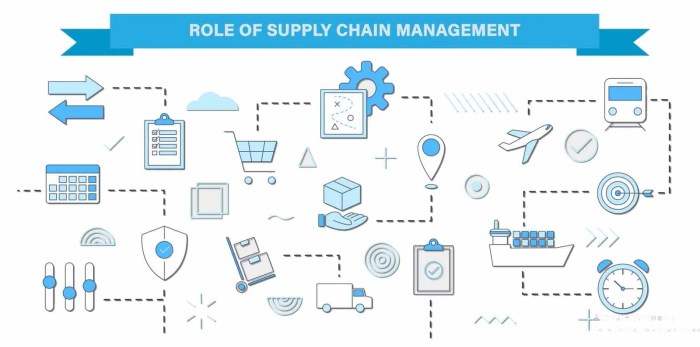
Effective supply chain management hinges on accurate budgeting and forecasting. Accounting plays a crucial role in this process, providing the financial framework and data analysis necessary for informed decision-making and efficient resource allocation. By integrating financial insights with operational data, businesses can create realistic plans that optimize inventory levels, streamline production, and minimize costs.
Accurate supply chain budgets and forecasts are essential for effective planning. Accounting contributes by providing historical financial data, analyzing cost drivers, and projecting future expenses. This involves gathering data on past sales, production costs, inventory levels, and transportation expenses. This historical data forms the foundation for developing realistic future projections. Furthermore, accounting expertise is vital in identifying potential cost savings and opportunities for process optimization within the supply chain. For example, analyzing transportation costs across different modes and carriers can reveal opportunities for significant cost reduction.
Integrating Financial and Operational Data for Supply Chain Planning
Integrating financial and operational data is crucial for comprehensive supply chain planning. Financial data, such as sales forecasts, historical costs, and profit margins, provides the overall financial context. Operational data, including inventory levels, production capacity, lead times, and supplier performance metrics, provides the granular details necessary to refine the financial projections. This integration often involves using enterprise resource planning (ERP) systems or specialized supply chain management (SCM) software that consolidates data from various sources. For instance, integrating sales forecasts from the CRM system with production capacity data from the manufacturing execution system (MES) allows for accurate production planning and prevents stockouts or overstocking. The result is a more comprehensive and accurate picture of the supply chain’s financial health and operational capabilities.
Variance Analysis in Monitoring Supply Chain Performance
Variance analysis is a critical tool for monitoring supply chain performance against the established budget. This involves comparing actual results to budgeted figures to identify discrepancies. Favorable variances, where actual performance exceeds expectations, indicate areas of strength or unexpected efficiency gains. Unfavorable variances, where actual performance falls short of expectations, highlight areas needing attention and potential problems. For example, a significant unfavorable variance in transportation costs might indicate a need to renegotiate contracts with carriers or explore alternative shipping routes. Detailed variance analysis can help pinpoint the root causes of these discrepancies, whether they are due to changes in market conditions, internal inefficiencies, or unforeseen events. This analysis informs corrective actions and improves future planning accuracy.
Forecasting Techniques and Their Accounting Implications
Various forecasting techniques can be employed in supply chain planning, each with its own accounting implications. Moving average methods, for example, smooth out fluctuations in historical data by averaging values over a specified period. This approach is relatively simple but may not accurately reflect seasonal trends or sudden shifts in demand. Exponential smoothing assigns exponentially decreasing weights to older data, giving more emphasis to recent observations. This method is more responsive to recent changes than moving averages. More sophisticated techniques, such as ARIMA (Autoregressive Integrated Moving Average) models, can capture complex patterns and seasonality, but require more statistical expertise. The choice of forecasting technique depends on the specific characteristics of the data and the desired level of accuracy. The accounting implications relate to the accuracy of the resulting budget and its impact on inventory management, production scheduling, and overall financial performance. For instance, an overly optimistic forecast could lead to overstocking and increased holding costs, while an overly pessimistic forecast could result in stockouts and lost sales. The selection of forecasting method should be carefully considered, factoring in the potential financial consequences of inaccuracies.
Auditing and Compliance in Supply Chain Management

Effective auditing and compliance are crucial for maintaining the integrity and efficiency of a supply chain. Robust internal controls, coupled with regular external audits, ensure the accuracy of financial reporting, mitigate risks, and foster trust among stakeholders. Without these mechanisms, supply chain operations can become vulnerable to errors, fraud, and regulatory penalties.
Internal Controls and Data Accuracy
Internal controls are the backbone of reliable supply chain accounting. These controls, encompassing processes, policies, and procedures, aim to safeguard assets, ensure the accuracy and completeness of financial data, promote operational efficiency, and comply with relevant regulations. Examples include segregation of duties (preventing one person from controlling all aspects of a transaction), authorization procedures (ensuring all transactions are approved by the appropriate individuals), regular reconciliation of accounts (comparing internal records to external statements), and inventory management systems (providing real-time visibility into stock levels and movements). Strong internal controls minimize the risk of errors, fraud, and mismanagement, leading to more reliable financial reporting and improved decision-making. The absence of robust internal controls can lead to inaccurate inventory counts, misstated costs, and ultimately, flawed financial statements.
Common Accounting Irregularities and Their Consequences
Several accounting irregularities can occur within supply chain operations. Inventory theft or shrinkage, for example, can lead to understated inventory values and inflated cost of goods sold. Fictitious transactions, such as creating false invoices or payments to shell companies, can divert funds and distort financial results. Improper revenue recognition, where revenue is recorded before it is earned, can mislead investors and stakeholders about the company’s financial performance. The consequences of these irregularities can be severe, including financial losses, reputational damage, legal penalties, and even criminal prosecution. For instance, a company failing to accurately account for inventory may experience stockouts, impacting customer satisfaction and sales.
The Role of External Audits in Assessing Supply Chain Financial Health and Compliance
External audits provide an independent assessment of a company’s financial statements and internal controls. Independent auditors, qualified professionals external to the organization, examine the financial records, review internal controls, and issue an opinion on the fairness and accuracy of the financial statements. This independent scrutiny helps to ensure the reliability of the financial information presented to investors, lenders, and other stakeholders. External audits also help identify areas of weakness in internal controls, allowing companies to strengthen their processes and reduce the risk of future irregularities. A clean audit opinion builds trust and confidence in the company’s financial reporting. Conversely, a qualified or adverse opinion can severely damage a company’s reputation and access to capital.
Best Practices for Maintaining Compliance with Accounting Regulations
Maintaining compliance with relevant accounting regulations, such as Generally Accepted Accounting Principles (GAAP) or International Financial Reporting Standards (IFRS), is paramount. Best practices include implementing a robust internal control framework, regularly reviewing and updating accounting policies and procedures, providing appropriate training to employees on accounting regulations and internal controls, and conducting regular internal audits to identify and address any weaknesses. Companies should also maintain detailed documentation of all transactions and ensure that their accounting systems are adequately designed to capture and process all relevant data. Regular communication with external auditors can help identify potential compliance issues early on. Furthermore, staying abreast of changes in accounting regulations is essential to ensure ongoing compliance. Proactive compliance measures not only mitigate risks but also enhance a company’s credibility and reputation.
Technology and Accounting in Supply Chain Management
The integration of technology is revolutionizing supply chain accounting, moving it from a largely manual, reactive function to a proactive, data-driven process. This shift allows for greater efficiency, improved accuracy, and enhanced decision-making capabilities. Advanced technologies are transforming how businesses track inventory, manage costs, and assess risk across their entire supply network.
Transformative Technologies in Supply Chain Accounting
Enterprise Resource Planning (ERP) systems, blockchain technology, and advanced data analytics are key drivers of this transformation. ERP systems consolidate data from various departments, providing a single source of truth for financial and operational information. Blockchain offers enhanced security and transparency in tracking goods and payments throughout the supply chain, reducing the risk of fraud and improving traceability. Data analytics tools allow for the extraction of meaningful insights from the vast amounts of data generated by these systems, leading to better forecasting, cost optimization, and risk mitigation.
Benefits and Challenges of Implementing Advanced Accounting Technologies
Implementing these technologies offers significant benefits, including improved data accuracy, reduced operational costs, enhanced visibility into supply chain activities, and better decision-making. However, challenges exist. High initial investment costs, the need for specialized expertise to implement and manage these systems, and the potential for data security breaches are significant hurdles. Furthermore, integrating new technologies with existing legacy systems can be complex and time-consuming. Successful implementation requires careful planning, robust change management strategies, and ongoing training for staff.
Data Analytics for Improved Supply Chain Decision-Making
Data analytics plays a crucial role in leveraging the potential of these technologies. For example, predictive analytics can forecast demand more accurately, reducing inventory holding costs and preventing stockouts. Prescriptive analytics can optimize transportation routes and warehouse locations, minimizing logistics expenses. Real-time data dashboards provide up-to-the-minute visibility into key performance indicators (KPIs), allowing managers to quickly identify and address potential problems. Analyzing historical data can reveal patterns and trends that might otherwise be missed, leading to more informed strategic decisions. For instance, analyzing sales data alongside weather patterns could reveal seasonal demand fluctuations, allowing for proactive inventory adjustments.
Comparison of Traditional and Technology-Enabled Supply Chain Accounting
| Feature | Traditional Supply Chain Accounting | Technology-Enabled Supply Chain Accounting |
|---|---|---|
| Data Collection | Manual, prone to errors | Automated, real-time data capture |
| Data Analysis | Limited, often retrospective | Advanced analytics, predictive modeling |
| Reporting | Slow, often delayed | Real-time reporting, customized dashboards |
| Cost Management | Difficult to track costs accurately across the entire supply chain | Precise cost allocation, identification of cost-saving opportunities |
End of Discussion
In conclusion, the role of accounting in supply chain management is undeniably pivotal. It extends far beyond mere bookkeeping, acting as a strategic partner in optimizing operations, mitigating risks, and driving profitability. By leveraging accurate cost accounting, robust inventory management systems, insightful financial reporting, and proactive risk assessment, organizations can build more efficient, resilient, and ultimately, successful supply chains. The integration of technology and data analytics further enhances the power of accounting, providing real-time visibility and facilitating data-driven decision-making for continuous improvement.
FAQ Section
What are some common accounting errors in supply chain management?
Common errors include inaccurate cost allocation, improper inventory valuation, inadequate internal controls, and failure to account for supply chain risks.
How does blockchain technology impact supply chain accounting?
Blockchain enhances transparency and traceability, improving data accuracy and reducing the risk of fraud by providing a secure, immutable record of transactions.
What are some key financial ratios used to assess supply chain performance?
Key ratios include inventory turnover, days sales outstanding, and return on assets. These provide insights into inventory efficiency, receivables management, and overall profitability.
How can accounting help mitigate supplier default risk?
Regular monitoring of supplier financial health through credit checks and performance evaluations, along with diversified sourcing strategies, can mitigate this risk.
Enhance your insight with the methods and methods of How to Track Online Sales Tax for E-commerce.