

The Role of Accounting in Mergers and Acquisitions is paramount. Successful mergers and acquisitions hinge on accurate financial information, meticulous planning, and a deep understanding of accounting principles. From initial due diligence and valuation to post-merger integration and ongoing compliance, accounting plays a pivotal role in every stage, shaping strategic decisions and ultimately determining the success or failure of the transaction. This exploration delves into the multifaceted ways accounting impacts this complex process.
The intricate dance of combining two distinct financial entities requires a precise understanding of accounting standards and practices. This involves not only evaluating the financial health of target companies but also forecasting future performance, structuring the transaction optimally for tax efficiency, and ensuring seamless integration of accounting systems. The effective management of intangible assets, often a significant part of the deal’s value, further underscores the crucial role of accounting expertise in M&A.
Due Diligence and Valuation

Accounting plays a pivotal role in mergers and acquisitions (M&A), particularly during the due diligence phase and subsequent valuation processes. A thorough understanding of a target company’s financial health is crucial for making informed decisions and negotiating favorable terms. This section explores the intricate relationship between accounting and the valuation of companies involved in M&A transactions.
Due diligence relies heavily on the accuracy and reliability of a target company’s financial statements. Accountants meticulously examine these statements – balance sheets, income statements, and cash flow statements – to assess the company’s financial position, profitability, and liquidity. This process involves verifying the accuracy of reported figures, identifying any inconsistencies or discrepancies, and evaluating the company’s accounting practices to ensure compliance with generally accepted accounting principles (GAAP) or International Financial Reporting Standards (IFRS).
In this topic, you find that How Economic Nationalism Affects Financial Transparency is very useful.
Accounting Methods Used in Valuation
Several accounting methods are employed to determine the fair market value of assets and liabilities during M&A transactions. These methods often involve adjustments to reported book values to reflect fair market values. The choice of method depends on factors such as the nature of the target company, the industry it operates in, and the specific goals of the acquirer.
Common methods include:
- Asset-Based Valuation: This method involves determining the fair market value of individual assets and liabilities, then summing them to arrive at a net asset value. This approach is particularly useful for companies with significant tangible assets.
- Income-Based Valuation: This method uses projected future earnings or cash flows to estimate the present value of the target company. Discounted cash flow (DCF) analysis is a common technique within this approach. This requires careful analysis of revenue streams, expense structures, and capital expenditures.
- Market-Based Valuation: This method relies on comparing the target company to similar publicly traded companies. It involves analyzing market multiples, such as price-to-earnings (P/E) ratios or enterprise value-to-EBITDA (EV/EBITDA) ratios, to arrive at a valuation. This requires careful selection of comparable companies and adjustments for differences in size, growth rates, and risk profiles.
Impact of Accounting Discrepancies on Valuation
Accounting discrepancies can significantly impact valuation and negotiation strategies. For example, unrecorded liabilities, understated expenses, or overstated assets can lead to an inflated valuation of the target company. Conversely, understated assets or unrecorded revenue streams could lead to an undervaluation. These discrepancies can cause significant disputes between buyers and sellers, potentially derailing the entire transaction. A classic example might involve the misclassification of capital expenditures as operating expenses, which would artificially inflate reported profits and consequently influence valuation multiples. Another example could be the failure to adequately account for potential environmental liabilities, which could dramatically affect the overall value once discovered.
Comparison of Valuation Methodologies
| Valuation Methodology | Data Used | Advantages | Disadvantages |
|---|---|---|---|
| Asset-Based Valuation | Balance sheet data, market values of assets | Relatively straightforward, objective | May not reflect intangible assets accurately, can be difficult to determine fair market values for all assets |
| Income-Based Valuation (DCF) | Projected cash flows, discount rate | Considers future earnings potential | Highly dependent on projections, sensitive to discount rate assumptions |
| Market-Based Valuation | Market multiples of comparable companies | Relatively simple, uses market data | Finding truly comparable companies can be difficult, market multiples can be volatile |
Financial Forecasting and Planning
Post-merger integration requires meticulous financial forecasting and planning to ensure a successful transition and achieve projected synergies. Accurate projections are crucial for securing financing, managing investor expectations, and making informed strategic decisions. This involves integrating the financial statements of both entities, identifying and quantifying synergies, and developing comprehensive financial models that reflect the combined entity’s future performance.
Creating accurate financial projections post-merger necessitates a robust methodology that considers various factors impacting the combined entity’s financial health. This involves integrating the financial statements of both entities, a process which often reveals discrepancies in accounting practices and requires careful reconciliation. Furthermore, the projections must account for potential synergies and cost savings, as well as any anticipated revenue enhancements. A well-structured financial forecast provides a roadmap for the post-merger entity, allowing for proactive management of resources and risks.
Methods for Creating Accurate Financial Projections Post-Merger
Accurate financial projections are built upon a foundation of reliable data and informed assumptions. The process involves several key steps: Firstly, a thorough analysis of the historical financial statements of both companies is crucial, identifying trends and key performance indicators (KPIs). Secondly, this historical data informs the development of realistic projections for key financial metrics such as revenue, expenses, and profitability. Thirdly, the projections should incorporate assumptions about market conditions, competitive landscape, and macroeconomic factors. Finally, sensitivity analysis should be conducted to assess the impact of various scenarios on the projected outcomes. For example, a merger between two companies in the technology sector might project increased revenue based on cross-selling opportunities and market expansion, but also factor in potential increased competition and R&D costs.
Synergy Identification and Quantification in Financial Forecasting
Synergy identification and quantification are critical components of post-merger financial forecasting. Synergies represent the value created by combining two entities that exceeds the sum of their individual values. These synergies can be operational (e.g., cost reductions through economies of scale), financial (e.g., improved access to capital), or commercial (e.g., increased market share). Quantifying these synergies requires detailed analysis and careful estimation. For instance, eliminating redundant administrative functions after a merger might generate significant cost savings, which can be quantified by analyzing the existing staffing levels, salaries, and operational costs of each company before the merger. These savings can then be incorporated into the projected expense structure.
Accounting’s Role in Identifying Cost Savings and Revenue Enhancements
Accounting plays a vital role in identifying and quantifying potential cost savings and revenue enhancements. By meticulously analyzing the financial statements of both entities, accountants can pinpoint areas where redundancies exist and where cost optimization is possible. Similarly, they can identify opportunities for revenue enhancement through cross-selling, market expansion, or improved pricing strategies. For example, a merger between two companies with overlapping customer bases might allow for more efficient marketing and sales efforts, leading to increased revenue. Accounting analysis can help determine the potential impact of such synergies on the combined entity’s profitability.
Step-by-Step Process for Consolidating Financial Statements
Consolidating financial statements post-merger involves a systematic process that considers various accounting standards. The process typically includes the following steps: First, a detailed analysis of the accounting policies and procedures of both companies is needed to identify any differences. Second, the necessary adjustments are made to ensure consistency in accounting practices. Third, the financial statements of the subsidiary are adjusted to reflect the ownership percentage of the parent company. Fourth, the adjusted financial statements of the subsidiary are then combined with those of the parent company. Finally, the consolidated financial statements are prepared in accordance with relevant accounting standards (e.g., IFRS or US GAAP). For example, differences in depreciation methods used by the two companies would need to be addressed to ensure consistency in the consolidated statements. The choice of accounting standard will significantly influence the consolidation process and the resulting financial statements.
Transaction Structuring and Tax Implications
The structure of a merger or acquisition (M&A) transaction significantly impacts both the accounting treatment and the tax implications for the involved parties. Choosing the right structure requires careful consideration of various factors, including the desired level of control, the seller’s objectives, and the overall tax efficiency of the deal. Understanding these complexities is crucial for both financial reporting and tax planning.
Accounting Treatments for Different M&A Transaction Structures
The accounting treatment of an M&A transaction hinges heavily on whether it’s structured as an asset purchase or a stock purchase. In an asset purchase, the acquiring company buys the target company’s individual assets and liabilities. This allows for selective acquisition and potentially a step-up in the basis of the acquired assets, leading to increased depreciation deductions. Conversely, in a stock purchase, the acquiring company buys the target company’s stock, inheriting all assets and liabilities. This structure generally preserves the target’s existing tax attributes, such as net operating losses (NOLs). The choice between these structures has significant implications for both the immediate and long-term financial statements of the acquiring company. For example, an asset purchase requires detailed asset valuation, while a stock purchase necessitates a comprehensive valuation of the target entity as a whole.
Tax Implications of Different Transaction Structures, The Role of Accounting in Mergers and Acquisitions
From a tax perspective, asset purchases and stock purchases offer distinct advantages and disadvantages. Asset purchases often allow the buyer to deduct the cost of acquired assets over time through depreciation and amortization, which can reduce their taxable income. However, they may also trigger capital gains taxes for the seller. Stock purchases, on the other hand, often defer capital gains taxes for the seller until they dispose of the acquired stock, although the buyer may not benefit from the same level of depreciation deductions. The tax implications also extend to the treatment of goodwill and other intangible assets, which are handled differently under each structure. For example, in an asset purchase, goodwill might be amortized over a period of time, while in a stock purchase, it is typically not amortizable.
Purchase Price Allocation in Acquisitions
Accounting principles, specifically those Artikeld in ASC 805, Business Combinations, dictate how the purchase price in an acquisition is allocated among the acquired assets and liabilities. This allocation is crucial because it directly affects the depreciation, amortization, and impairment charges recognized in future financial statements. The purchase price is allocated based on the fair values of identifiable assets and liabilities at the acquisition date. Any remaining amount after allocating to identifiable assets and liabilities is recorded as goodwill. This process is complex and requires detailed valuations performed by qualified professionals. For instance, if a company acquires another for $100 million, and the fair value of identifiable net assets is $80 million, the remaining $20 million is recorded as goodwill. Accurate purchase price allocation is critical for ensuring the reliability of financial reporting and for long-term financial planning.
Potential Tax Optimization Strategies in M&A Transactions
Careful planning can significantly impact the tax burden associated with M&A transactions. Several strategies can help optimize tax outcomes.
- Structuring the transaction as an asset purchase or stock purchase to minimize tax liabilities. The optimal structure depends on the specific circumstances of the transaction and the relative tax positions of the buyer and seller.
- Utilizing tax credits and deductions available to businesses. This could include research and development tax credits, investment tax credits, or deductions for depreciation and amortization.
- Effective planning for the treatment of intangible assets. Properly allocating the purchase price to intangible assets can influence the amortization schedule and reduce the tax burden over time.
- Leveraging net operating losses (NOLs) of the acquired company. NOLs can be used to offset future taxable income, reducing the overall tax liability.
- Careful consideration of state and local tax implications. State and local tax laws can vary significantly, impacting the overall tax efficiency of the transaction.
Post-Merger Integration and Reporting: The Role Of Accounting In Mergers And Acquisitions
Successfully integrating two companies after a merger or acquisition requires meticulous planning and execution, and accounting plays a crucial role in this process. The complexities involved extend beyond simply combining financial statements; it encompasses the harmonization of diverse accounting systems, processes, and reporting structures, demanding a strategic and systematic approach. This section will explore the challenges and procedures involved in post-merger accounting integration and reporting.
Integrating different accounting systems and processes after a merger presents significant challenges. Companies often utilize different accounting software, chart of accounts, and internal controls. Reconciling these discrepancies and establishing a unified system requires considerable time, resources, and expertise. Data migration can be fraught with errors, leading to inaccuracies in financial reporting. Furthermore, cultural differences in accounting practices between the merging entities can complicate the integration process, requiring careful consideration of different accounting standards and internal controls. The timeline for integration can be significantly impacted by the scale and complexity of the merging companies’ systems, potentially delaying the realization of post-merger synergies.
Challenges in Integrating Accounting Systems and Processes
The process of integrating accounting systems post-merger involves several key challenges. Differences in software, chart of accounts structures, and data formats require extensive data mapping and conversion efforts. This often involves significant manual intervention, increasing the risk of human error. The need to maintain operational continuity during the integration phase necessitates a phased approach, minimizing disruption to ongoing business activities. In addition, ensuring data integrity throughout the migration process is paramount, requiring robust data validation and reconciliation procedures. Failure to address these challenges effectively can lead to significant delays, cost overruns, and inaccuracies in financial reporting. For example, a large merger between two multinational companies might take several years to fully integrate their accounting systems, requiring substantial investment in technology and personnel.
Consolidating Financial Statements Post-Merger
Consolidating financial statements after a merger involves combining the financial data of the acquiring and acquired companies. This requires adjustments to reflect the acquisition date, fair value accounting for acquired assets and liabilities, and the elimination of intercompany transactions. The process typically begins with the preparation of a purchase price allocation, which assigns the purchase price to identifiable assets and liabilities based on their fair values. Goodwill, representing the excess of the purchase price over the net identifiable assets, is then recognized as an intangible asset. Consolidated financial statements present the combined financial position, performance, and cash flows of the merged entity, providing a comprehensive overview of the post-merger financial health. This process adheres to generally accepted accounting principles (GAAP) or International Financial Reporting Standards (IFRS), depending on the jurisdiction. A crucial step is the preparation of a reconciliation schedule to ensure the accuracy and completeness of the consolidated statements.
Importance of Accurate and Timely Financial Reporting Post-Merger
Accurate and timely financial reporting is critical for various stakeholders after a merger. Investors require reliable information to assess the performance of the merged entity and make informed investment decisions. Creditors need accurate financial data to evaluate the creditworthiness of the company. Regulatory bodies rely on timely and accurate reporting to ensure compliance with relevant laws and regulations. Internal management uses financial reporting to monitor the success of the integration process, identify potential issues, and make informed decisions regarding resource allocation and strategic planning. Delayed or inaccurate reporting can erode investor confidence, negatively impact credit ratings, and expose the company to regulatory penalties. Therefore, establishing efficient and reliable post-merger reporting systems is crucial for the long-term success of the merged entity.
Monitoring Integration Success Using Accounting Data
Accounting data provides valuable insights into the success of the post-merger integration process. Key performance indicators (KPIs) such as revenue growth, profitability margins, and operating efficiency can be tracked to assess the achievement of integration goals. Variance analysis, comparing actual results against pre-merger projections, helps identify areas where integration is proceeding smoothly and where challenges persist. Detailed cost analysis can reveal synergies realized and areas where cost savings are lagging. Analyzing customer retention rates and market share post-merger provides insights into the impact of the integration on customer relationships and competitive positioning. By closely monitoring these key metrics, management can identify potential issues early on and take corrective actions to ensure a successful integration. For instance, a significant drop in customer satisfaction scores after a merger might indicate problems with integrating customer service operations.
Accounting for Intangible Assets
Intangible assets represent a significant portion of a company’s value, particularly in sectors like technology and pharmaceuticals. Their proper accounting treatment during mergers and acquisitions (M&A) is crucial for accurate financial reporting and informed decision-making by stakeholders. This section will explore the complexities involved in accounting for intangible assets within the context of M&A transactions.
Intangible assets, unlike tangible assets, lack physical substance. They represent valuable rights and privileges, contributing significantly to a company’s earning potential. In M&A, the acquisition price often reflects the value of these intangible assets, which need to be appropriately recognized and measured on the acquirer’s balance sheet. Key challenges arise in their valuation and subsequent amortization.
Valuation of Intangible Assets
Valuing intangible assets is inherently subjective and complex. Unlike tangible assets with readily available market prices, intangible assets require specialized valuation techniques. Common approaches include the market approach (comparing similar assets traded in the market), the income approach (estimating future cash flows generated by the asset), and the cost approach (estimating the cost of recreating the asset). The choice of method depends on the specific asset and the availability of reliable data. For example, a well-established brand might be valued using the market approach by referencing similar brands’ market capitalization, while a newly developed patent might be valued using the income approach, projecting its future licensing revenue. The selection of the appropriate valuation method significantly impacts the final acquisition price and subsequent accounting treatment. Inaccurate valuation can lead to misrepresentation of the acquirer’s financial position and potentially affect future investment decisions.
Amortization of Intangible Assets
Once valued and recognized, most intangible assets (excluding goodwill) are subject to amortization, which systematically allocates their cost over their useful economic lives. Determining the useful life of an intangible asset is another significant challenge. This requires careful consideration of factors such as technological advancements, market competition, and legal protection. For instance, the useful life of a patent might be limited by its expiration date, while the useful life of a brand name could be significantly longer, potentially indefinite. The amortization method chosen (straight-line or other systematic methods) also influences the reported financial results. Overestimating the useful life can lead to under-amortization, while underestimating it results in over-amortization, impacting profitability and return on investment calculations.
Impact on Financial Reporting and Decision-Making
The accounting treatment of intangible assets directly impacts key financial metrics such as earnings per share (EPS), return on assets (ROA), and goodwill impairment testing. For example, overstating the value of an intangible asset leads to inflated asset values and potentially higher reported profits in the short term. However, this can lead to future impairment charges if the asset’s value declines, negatively impacting subsequent financial statements. Conversely, understating the value of intangible assets can lead to understated asset values and potentially lower reported profits. This can misrepresent the true financial health of the company and influence investment decisions. Accurate accounting for intangible assets is thus critical for ensuring transparency and fair representation of a company’s financial performance.
Visual Representation of Intangible Assets in M&A
Imagine a Venn diagram. The central circle represents the acquired company. Three overlapping circles branch out from the central circle, representing the major categories of intangible assets: 1) Intellectual Property: This includes patents, trademarks, copyrights, and trade secrets. This section is labeled with examples and their accounting implications (e.g., patent amortization, trademark renewal costs). 2) Customer Relationships: This includes customer lists, brand recognition, and customer loyalty programs. This section is labeled with examples and their accounting implications (e.g., customer relationship management system costs, brand valuation). 3) Operational Capabilities: This includes specialized knowledge, skilled workforce, and efficient processes. This section is labeled with examples and their accounting implications (e.g., training costs, employee retention strategies). The overlapping areas represent the synergistic effects of combining these assets, leading to enhanced value for the acquiring company. Outside the main circles but connected by dotted lines, is a large circle labeled “Goodwill,” representing the excess of the purchase price over the fair value of identifiable net assets. This highlights that goodwill is not amortized but is subject to impairment testing. The entire diagram illustrates how the various components of intangible assets are accounted for, individually and collectively, during an M&A transaction.
Financial Reporting and Compliance
Mergers and acquisitions (M&A) transactions necessitate meticulous financial reporting and unwavering compliance with relevant accounting standards and regulations. The accuracy and transparency of financial information are crucial not only for regulatory compliance but also for attracting investors, securing financing, and ensuring the long-term success of the merged entity. Failure to comply can lead to significant financial penalties, reputational damage, and even legal action.
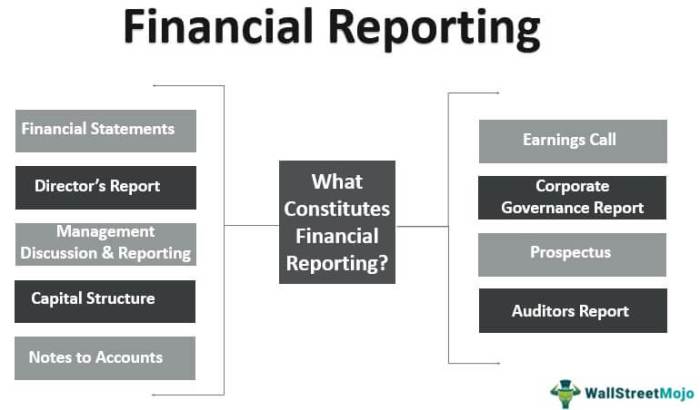
Accurate financial record-keeping is paramount throughout the entire M&A process, from initial due diligence to post-merger integration. This involves the careful consolidation of financial statements, the proper accounting for intangible assets, and the transparent disclosure of all relevant financial information to stakeholders. The complexities involved necessitate a thorough understanding of applicable accounting standards and regulations.
Key Accounting Standards and Regulations
M&A transactions are governed by a variety of accounting standards and regulations, primarily International Financial Reporting Standards (IFRS) and Generally Accepted Accounting Principles (GAAP). The specific standards applied will depend on the jurisdictions in which the involved companies operate and the type of transaction. Key standards include IFRS 3 Business Combinations and its equivalent under GAAP, ASC 805, which provide detailed guidance on accounting for the acquisition of businesses. These standards dictate how the purchase price is allocated to the acquired assets and liabilities, including the recognition and measurement of goodwill. Furthermore, regulations concerning financial reporting transparency and disclosure vary by jurisdiction and impact the preparation of consolidated financial statements post-merger. Compliance demands careful attention to detail and expert guidance.
Maintaining Accurate Financial Records for Regulatory Compliance
Maintaining accurate financial records is not merely a matter of good practice; it is a legal obligation. Regulatory bodies like the Securities and Exchange Commission (SEC) in the US and equivalent bodies globally scrutinize financial reporting related to M&A activity. Accurate records provide a verifiable audit trail, facilitating smooth regulatory reviews and minimizing the risk of penalties or sanctions. This involves meticulous documentation of all transactions, valuations, and allocations. Robust internal controls, including segregation of duties and regular internal audits, are essential for maintaining data integrity and preventing fraud. The use of enterprise resource planning (ERP) systems can streamline the process and enhance accuracy. For example, a failure to properly account for deferred revenue or liabilities in the acquisition could lead to significant misstatements in financial reporting and subsequent regulatory scrutiny.
Consequences of Non-Compliance
Non-compliance with accounting regulations in M&A transactions can have severe consequences. These can range from financial penalties and legal action to reputational damage and loss of investor confidence. Regulatory fines can be substantial, and legal battles can be protracted and costly. Moreover, inaccuracies in financial reporting can mislead investors and creditors, leading to potential legal claims and significant financial losses. For instance, misrepresentation of financial information during an acquisition could result in lawsuits from shareholders who suffered losses due to the inaccurate information. A lack of transparency can damage the reputation of the involved companies, making it difficult to secure future financing or attract investors.
Checklist for Accounting Procedures and Documentation
Proper accounting procedures and thorough documentation are vital for compliance during and after an M&A deal. The following checklist provides a framework for ensuring compliance:
| Procedures | Documentation |
|---|---|
| Pre-acquisition due diligence review of target’s financial statements | Due diligence reports, working papers, and supporting schedules |
| Valuation of assets and liabilities | Valuation reports, supporting calculations, and assumptions |
| Allocation of purchase price to acquired assets and liabilities | Purchase agreement, allocation schedule, and supporting documentation |
| Consolidation of financial statements | Consolidated financial statements, working papers, and accounting policies |
| Preparation of post-merger financial reports | Financial statements, disclosures, and management reports |
| Internal controls assessment and implementation | Internal control documentation, audit reports, and remediation plans |
| Compliance with relevant accounting standards (IFRS/GAAP) | Accounting policy manuals, technical memorandums, and legal opinions |
| Regular internal and external audits | Audit reports, management letters, and corrective action plans |
Epilogue
In conclusion, the role of accounting in mergers and acquisitions extends far beyond simple bookkeeping. It is a strategic function that informs critical decisions at every phase, from initial valuation to post-merger integration and ongoing compliance. Mastering the complexities of accounting in this context is crucial for navigating the inherent challenges and maximizing the potential for a successful outcome. A thorough understanding of accounting principles, coupled with effective financial planning and forecasting, is essential for mitigating risk and unlocking the synergies that drive successful M&A transactions.
FAQ Summary
What are some common accounting challenges in cross-border M&A?
Cross-border deals introduce complexities like differing accounting standards (IFRS vs. GAAP), currency fluctuations, and varying regulatory environments, requiring specialized expertise.
How does accounting impact the negotiation process in an M&A?
Accounting data directly influences valuation, identifying potential discrepancies that can affect purchase price negotiations. A thorough understanding of the target’s financial position provides a strong negotiating stance.
What is the significance of post-merger accounting integration?
Successful integration of accounting systems and processes is crucial for accurate financial reporting, efficient operations, and compliance post-merger. Failure to do so can lead to significant operational inefficiencies and regulatory issues.
How can accounting help identify potential risks in an M&A?
Detailed financial analysis through accounting can reveal hidden liabilities, inconsistencies, or potential future financial challenges, allowing for better risk assessment and mitigation strategies.