




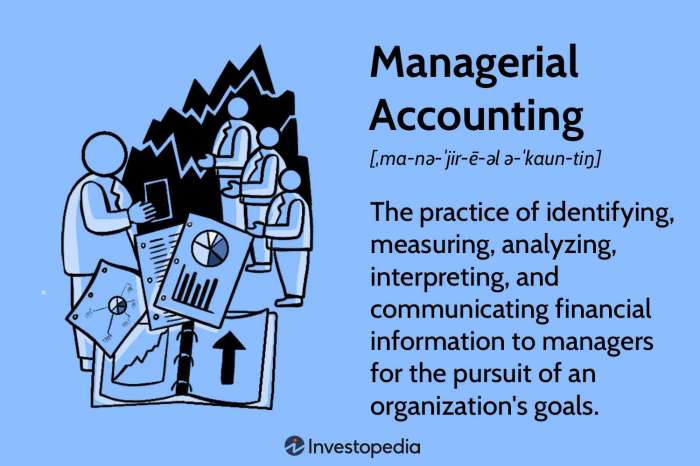
The Basics of Managerial Accounting for Business Owners: Understanding the financial heartbeat of your business is crucial for success. This guide demystifies managerial accounting, showing how it differs from financial accounting and provides actionable insights for informed decision-making. We’ll explore key concepts like cost accounting, budgeting, performance evaluation, and using financial statements to steer your business towards profitability.
From classifying costs and creating budgets to analyzing performance and making strategic choices, we’ll equip you with the fundamental knowledge needed to navigate the complexities of managing your business finances effectively. This isn’t just about numbers; it’s about understanding how those numbers translate into strategic advantages and ultimately, a more prosperous future for your enterprise.
Introduction to Managerial Accounting
Managerial accounting is a crucial tool for small business owners, providing the insights needed to make informed decisions and drive profitability. Unlike financial accounting, which focuses on external reporting, managerial accounting is geared towards internal use, empowering owners to understand their business’s performance and make strategic choices. It’s about using financial data to improve operations and achieve business goals.
Managerial accounting offers a detailed, real-time view of a business’s financial health, enabling proactive management rather than reactive problem-solving. This proactive approach allows for better resource allocation, improved efficiency, and ultimately, greater success.
Key Differences Between Managerial and Financial Accounting
Managerial and financial accounting serve distinct purposes and differ significantly in their approach. Financial accounting adheres to generally accepted accounting principles (GAAP) or International Financial Reporting Standards (IFRS), producing standardized reports for external stakeholders like investors and creditors. These reports provide a historical overview of financial performance. In contrast, managerial accounting uses data tailored to the specific needs of the business owner, often employing customized reports and projections. It’s forward-looking and less rigid in its reporting requirements.
| Feature | Managerial Accounting | Financial Accounting |
|---|---|---|
| Purpose | Internal decision-making | External reporting |
| Users | Managers, employees | Investors, creditors, government |
| Time Focus | Future-oriented (projections, budgets) | Past-oriented (historical data) |
| Reporting Frequency | Regular, as needed | Periodic (quarterly, annually) |
| Rules and Regulations | No strict rules | GAAP or IFRS compliance |
Examples of Managerial Accounting in Business Decision-Making
Managerial accounting provides a wealth of information that directly impacts decision-making. For example, analyzing cost behavior (fixed versus variable costs) can help determine pricing strategies. A business owner might use cost-volume-profit (CVP) analysis to predict profits at different sales volumes. Consider a bakery owner who wants to introduce a new cupcake flavor. They can use managerial accounting techniques to estimate the cost of ingredients, labor, and marketing, projecting the break-even point and potential profitability before launching the product. This prevents costly mistakes and allows for informed resource allocation.
Another example is the use of budgeting. A well-constructed budget helps small business owners allocate resources effectively, track progress toward goals, and identify potential problems early on. Imagine a small landscaping company using a budget to forecast expenses like equipment maintenance, fuel costs, and labor, allowing them to secure necessary funding and avoid unexpected financial shortfalls. Variance analysis, comparing actual results to budgeted amounts, helps identify areas needing attention and allows for corrective action. Finally, performance evaluation metrics, like key performance indicators (KPIs), can be tracked and analyzed to assess the effectiveness of different strategies and make data-driven adjustments. For instance, a retail store might track customer acquisition cost (CAC) and customer lifetime value (CLTV) to optimize marketing spend.
Cost Accounting Basics

Understanding your costs is fundamental to running a profitable business. Cost accounting provides the tools and techniques to track, analyze, and manage these costs effectively. This section will explore the basics of cost accounting, focusing on cost classification and the design of a simple cost accounting system.
Cost Classification Methods
Businesses classify costs in various ways to facilitate better decision-making. The most common classifications include fixed versus variable costs, and direct versus indirect costs. Understanding these distinctions is crucial for accurate cost analysis and effective financial planning.
Fixed costs remain constant regardless of the production volume, such as rent or salaries. Variable costs, on the other hand, change directly with production levels, such as raw materials. Direct costs are directly attributable to a specific product or service, like the cost of raw materials used in manufacturing a widget. Indirect costs, also known as overhead, are not directly traceable to a single product but are necessary for production, such as factory rent or utilities. Some costs may exhibit characteristics of both fixed and variable costs, these are known as semi-variable costs. For example, electricity costs might include a fixed base charge plus a variable charge based on consumption.
Designing a Simple Cost Accounting System for a Small Business
Let’s consider a hypothetical small bakery, “Sweet Success.” A simple cost accounting system for Sweet Success could involve tracking direct costs like flour, sugar, and butter for each type of baked good. Indirect costs, such as rent, utilities, and baker’s salaries, would be allocated across all products based on a reasonable allocation method, perhaps based on labor hours or oven time used for each product. By meticulously recording these costs, Sweet Success can determine the cost of goods sold (COGS) for each product, enabling accurate pricing and profitability analysis. They could use a spreadsheet to track daily sales and expenses, or a more sophisticated accounting software. Regularly reviewing these figures allows them to identify areas for cost reduction or price adjustments.
The Importance of Accurate Cost Tracking for Profitability Analysis, The Basics of Managerial Accounting for Business Owners
Accurately tracking costs is paramount for assessing a business’s profitability. Without precise cost data, pricing decisions are guesswork, and identifying profitable and unprofitable products or services becomes impossible. For example, if Sweet Success underestimates the cost of producing its specialty cakes, they might price them too low, leading to losses despite high sales volume. Conversely, overestimating costs could lead to underselling and lost revenue opportunities. Accurate cost accounting allows for informed decisions regarding pricing, production levels, and resource allocation, ultimately leading to improved profitability and business sustainability.
Comparison of Cost Accounting Methods
| Method Name | Description | Advantages | Disadvantages |
|---|---|---|---|
| Job Order Costing | Assigns costs to individual jobs or projects. | Provides detailed cost information for each job; useful for customized products. | Can be labor-intensive and complex for businesses with many small jobs. |
| Process Costing | Averages costs over a large number of identical units. | Suitable for mass production; simpler and less costly than job order costing. | Less precise cost information for individual units; not suitable for customized products. |
| Activity-Based Costing (ABC) | Allocates overhead costs based on activities that consume resources. | More accurate cost allocation than traditional methods; helps identify cost drivers. | More complex and time-consuming to implement; requires detailed data collection. |
| Lean Accounting | Focuses on reducing waste and improving efficiency. | Identifies areas for cost reduction; improves operational efficiency. | Requires a strong commitment to lean principles throughout the organization. |
Budgeting and Forecasting

Budgeting and forecasting are crucial for the financial health of any small business. A well-crafted budget provides a roadmap for achieving financial goals, while accurate forecasting helps anticipate challenges and capitalize on opportunities. Both processes are iterative and should be regularly reviewed and adjusted based on performance.
Creating a realistic annual budget for a small business involves a structured approach combining financial planning with an understanding of market conditions and operational realities. This process should not be viewed as a rigid exercise, but rather as a dynamic tool for managing resources and guiding decision-making throughout the year.
Budgeting Techniques
Several budgeting techniques can be employed, each with its own advantages and disadvantages. The choice depends on the specific needs and circumstances of the business. Understanding these different approaches allows for a more tailored and effective budgeting process.
For example, zero-based budgeting starts from scratch each year, requiring justification for every expense. This approach can be time-consuming but ensures that all spending aligns with current priorities. Incremental budgeting, on the other hand, uses the previous year’s budget as a starting point, adjusting for anticipated changes. This method is quicker but may not be as effective in identifying areas for cost reduction.
Investigate the pros of accepting The Impact of Digital Identity Verification on Financial Auditing in your business strategies.
Budget Monitoring and Variance Analysis
Regular monitoring of the budget is essential to ensure that the business stays on track. This involves comparing actual results to the budgeted amounts and analyzing any variances. Understanding the reasons behind these variances is crucial for making informed adjustments and preventing potential problems.
For instance, a significant variance in sales revenue could be due to factors such as seasonal changes, increased competition, or a successful marketing campaign. Similarly, a variance in expenses might indicate inefficiencies in operations or unexpected cost increases. Analyzing these variances helps to identify areas requiring attention and allows for proactive adjustments to the budget.
Sales Forecasting Using Historical Data and Market Trends
Creating an accurate sales forecast is vital for effective budgeting and resource allocation. This process involves analyzing historical sales data, considering market trends, and incorporating any anticipated changes in the business environment. A step-by-step guide is essential for a comprehensive forecast.
- Gather Historical Data: Collect sales data from previous periods (e.g., monthly or quarterly sales figures for the past 3-5 years). This data should be broken down by product or service line, if applicable.
- Analyze Trends: Identify any patterns or trends in the historical data. For example, are sales consistently higher during certain months or seasons? Are there any noticeable upward or downward trends?
- Consider Market Trends: Research relevant market trends that could impact sales. This could include economic conditions, competitor activity, changes in consumer preferences, or new technologies.
- Incorporate Business Changes: Account for any anticipated changes in the business, such as new product launches, marketing campaigns, or changes in pricing strategies.
- Develop the Forecast: Use the gathered data and insights to develop a sales forecast. This could involve using simple methods like averaging past sales or more sophisticated techniques like regression analysis. A common simple approach is to use a percentage increase or decrease based on historical growth.
- Review and Adjust: Regularly review and adjust the sales forecast as new information becomes available. This will ensure that the forecast remains accurate and relevant.
For example, a small bakery might analyze its sales data from the past three years to observe a consistent increase in sales during the holiday season. They could then incorporate this seasonal trend into their sales forecast for the upcoming year, projecting higher sales during those months. Further, if they are planning a new marketing campaign, they might factor in an expected increase in sales based on the campaign’s anticipated effectiveness.
Decision Making using Managerial Accounting Data
Managerial accounting data provides crucial insights for informed business decisions. By analyzing costs, revenues, and other key performance indicators, business owners can make strategic choices that optimize profitability and resource allocation. This section explores how cost-volume-profit (CVP) analysis, break-even analysis, and other managerial accounting tools facilitate effective decision-making.
Cost-Volume-Profit (CVP) Analysis in Pricing Decisions
CVP analysis is a powerful tool for understanding the relationship between costs, volume, and profit. It helps businesses determine the selling price needed to achieve a desired profit level, considering various cost structures. By analyzing fixed costs (costs that remain constant regardless of production volume), variable costs (costs that change directly with production volume), and sales price, businesses can model different pricing scenarios and assess their impact on profitability. For example, a business might use CVP analysis to determine whether a small increase in price will significantly improve profitability or if a higher volume of sales at a lower price will be more beneficial. The formula for calculating break-even point in units is:
Break-even point (units) = Fixed Costs / (Sales Price per Unit – Variable Cost per Unit)
This formula allows businesses to determine the number of units they need to sell to cover all their costs and achieve zero profit. By modifying the sales price variable in this equation, a business can explore the impact of various pricing strategies on their break-even point.
Break-Even Analysis for Sales Target Determination
Break-even analysis, a core component of CVP analysis, helps determine the sales volume required to cover all costs and reach a point of no profit or loss. This is critical for setting realistic sales targets and managing expectations. Understanding the break-even point allows businesses to assess the feasibility of their sales projections and make necessary adjustments to their strategies. For instance, if a business discovers their break-even point is significantly higher than their projected sales, they might need to adjust their pricing strategy, reduce costs, or explore new market opportunities.
Managerial Accounting Data and Decisions on Product Mix and Resource Allocation
Managerial accounting data plays a vital role in optimizing product mix and resource allocation. By analyzing the profitability of individual products or product lines, businesses can identify which products are most profitable and allocate resources accordingly. This might involve prioritizing production of high-margin products, investing in marketing campaigns for successful items, or discontinuing unprofitable product lines. Furthermore, by analyzing the cost of different resources (labor, materials, etc.), businesses can make informed decisions on how to allocate those resources most effectively to maximize overall profitability. For example, a company might choose to invest in more efficient machinery if the analysis shows that the cost savings will outweigh the initial investment cost.
Case Study: Small Business Profitability Improvement through Managerial Accounting
This case study illustrates how a small bakery, “Sweet Success,” used managerial accounting to improve its profitability:
- Problem: Sweet Success was experiencing inconsistent profitability. They lacked a clear understanding of their costs and pricing strategy.
- Solution: They implemented a managerial accounting system to track their costs (ingredients, labor, rent, utilities), sales revenue, and inventory levels. They conducted a CVP analysis to determine their break-even point and optimal pricing strategy.
- Implementation: They used spreadsheets to track their data and created simple reports that showed their costs, revenues, and profits on a weekly basis.
- Results: By analyzing their data, Sweet Success identified that their labor costs were disproportionately high during peak hours. They adjusted their staffing levels and optimized their baking schedule. Their CVP analysis indicated that a slight price increase for their most popular items would significantly increase profitability without impacting sales volume. The bakery experienced a 15% increase in profit within three months of implementing these changes.
Analyzing Financial Statements for Managerial Purposes
Understanding and interpreting financial statements is crucial for effective managerial decision-making. These statements provide a snapshot of a business’s financial health, allowing managers to track performance, identify areas for improvement, and make informed choices about the future. By moving beyond simply reviewing the numbers, managers can leverage financial statement analysis to gain valuable insights into their business’s strengths and weaknesses.
Financial statement analysis, when used effectively, allows managers to assess the overall financial health of their businesses. The process involves a detailed examination of the income statement, balance sheet, and cash flow statement to understand the relationships between different aspects of the business’s financial performance. This understanding is crucial for informed decision-making in areas such as resource allocation, cost control, and strategic planning.
Interpreting Key Financial Statements
The income statement shows a company’s revenues and expenses over a period of time, resulting in net income or net loss. Managers use this to track profitability, identify trends in sales and costs, and assess the effectiveness of pricing strategies. The balance sheet provides a snapshot of a company’s assets, liabilities, and equity at a specific point in time. This helps managers understand the company’s financial position, liquidity, and solvency. Finally, the cash flow statement tracks the movement of cash into and out of the business over a period. Managers use this to monitor cash flow, assess liquidity, and plan for future cash needs. For example, a manager might analyze a decrease in cash flow from operations in conjunction with an increase in accounts receivable to identify potential issues with collection procedures.
Ratio Analysis for Financial Health Assessment
Ratio analysis involves calculating various ratios from financial statement data to assess different aspects of a business’s performance. Profitability ratios, such as gross profit margin and net profit margin, indicate how efficiently a company is generating profits. Liquidity ratios, like the current ratio and quick ratio, measure a company’s ability to meet its short-term obligations. Solvency ratios, such as the debt-to-equity ratio and times interest earned ratio, assess a company’s long-term financial stability. For instance, a consistently low current ratio might indicate a need for improved cash management or increased working capital. A high debt-to-equity ratio might suggest a need for a more conservative financial strategy.
Limitations of Financial Statements Alone
While financial statements are invaluable tools, relying solely on them for managerial decision-making has limitations. Financial statements present historical data, which may not accurately reflect future performance. They also do not capture qualitative factors, such as employee morale, brand reputation, or technological advancements, which can significantly impact a business’s success. Additionally, financial statements can be manipulated, making it essential to consider other sources of information for a comprehensive understanding of the business’s overall health. For example, a company might appear highly profitable based on its income statement, but if its cash flow statement reveals significant cash outflow, it indicates potential underlying problems. A thorough analysis requires a broader perspective, integrating financial data with operational and market intelligence.
Final Summary: The Basics Of Managerial Accounting For Business Owners
Mastering the basics of managerial accounting empowers small business owners to transition from reactive to proactive management. By understanding your costs, creating realistic budgets, and effectively analyzing performance, you gain the tools to make data-driven decisions that propel growth and profitability. This isn’t just about bookkeeping; it’s about strategic financial leadership. Armed with this knowledge, you can confidently navigate the financial landscape and build a thriving business.
Questions Often Asked
What is the difference between managerial and financial accounting?
Managerial accounting focuses on internal use by management for decision-making, while financial accounting provides external reports for stakeholders like investors and creditors.
How often should I review my budget?
Regularly, ideally monthly, to identify variances and make necessary adjustments. More frequent reviews might be needed depending on the business’s volatility.
What are some common KPIs for small businesses?
Examples include revenue growth, customer acquisition cost, customer lifetime value, profit margin, and inventory turnover.
Can I use spreadsheet software for managerial accounting?
Yes, many small businesses effectively use spreadsheets like Excel or Google Sheets for basic managerial accounting tasks. However, more sophisticated businesses might benefit from dedicated accounting software.