




How to Develop an Effective Financial Reporting System is crucial for any organization seeking transparency and efficient financial management. This guide explores the key steps involved, from defining reporting requirements and choosing data input methods to designing compelling reports and ensuring system security. We’ll cover best practices, address common challenges, and provide actionable strategies for building a system that supports informed decision-making and sustainable growth.
Developing a robust financial reporting system is more than just creating spreadsheets; it’s about building a comprehensive infrastructure that accurately reflects an organization’s financial health. This involves careful consideration of data sources, processing methods, and presentation styles, all while maintaining data integrity and security. This guide provides a step-by-step approach, making the process manageable and achievable for businesses of all sizes.
Defining Requirements for an Effective System
Building a robust financial reporting system requires careful planning and a clear understanding of its purpose. An effective system streamlines financial processes, improves accuracy, and provides timely, reliable data for informed decision-making. This involves defining specific requirements, identifying key performance indicators, and ensuring alignment with relevant accounting standards.
Core Components of a Robust Financial Reporting System
A robust financial reporting system comprises several interconnected components working in harmony. These include a comprehensive chart of accounts, a secure and efficient data entry system, automated workflows for processing transactions, a reliable database for storing financial data, and reporting modules capable of generating various financial statements and analyses. The system should also incorporate robust internal controls to ensure data integrity and prevent fraud. For example, segregation of duties, access controls, and regular data backups are crucial elements of a secure system. Furthermore, integration with other enterprise systems, such as inventory management and customer relationship management (CRM), is essential for a holistic view of the business.
Key Performance Indicators (KPIs) for Tracking and Reporting
The selection of KPIs depends on the specific goals and objectives of the organization. However, some common KPIs include profitability ratios (gross profit margin, net profit margin), liquidity ratios (current ratio, quick ratio), solvency ratios (debt-to-equity ratio), efficiency ratios (inventory turnover, accounts receivable turnover), and return on investment (ROI). Tracking these KPIs allows for monitoring financial health, identifying areas for improvement, and making data-driven decisions. For instance, a consistently low inventory turnover might indicate a need for improved inventory management strategies. Similarly, a high debt-to-equity ratio could signal increased financial risk.
Alignment with Accounting Standards
Adherence to generally accepted accounting principles (GAAP) or International Financial Reporting Standards (IFRS) is paramount for the credibility and reliability of financial reports. The chosen accounting framework dictates how transactions are recorded, assets are valued, and financial statements are presented. Non-compliance can lead to inaccurate reporting, legal issues, and loss of investor confidence. For example, using the wrong depreciation method can significantly impact reported profits and asset values. Therefore, the system must be designed to support the chosen accounting standards and ensure consistent application of these standards across all financial reporting processes.
Stakeholders and Their Reporting Needs
Understanding the information needs of various stakeholders is crucial for designing a truly effective reporting system. The system should cater to the specific requirements of each group.
- Management: Requires detailed financial statements, variance analyses, and KPIs to monitor performance, make strategic decisions, and track progress towards goals. They need real-time dashboards and customized reports.
- Investors: Need audited financial statements prepared according to GAAP or IFRS, providing a clear picture of the company’s financial position, performance, and cash flows. They focus on profitability, liquidity, and solvency.
- Creditors: Require information to assess the company’s creditworthiness and ability to repay loans. Key metrics include liquidity ratios, debt levels, and cash flow statements.
- Governmental Agencies: Need compliance reports and tax filings that adhere to all relevant regulations. The reporting requirements vary depending on the jurisdiction and the nature of the business.
- Internal Auditors: Require access to detailed transaction data and audit trails to conduct internal audits and ensure the integrity of financial information. They need comprehensive reporting to assess the effectiveness of internal controls.
Data Collection and Input Methods
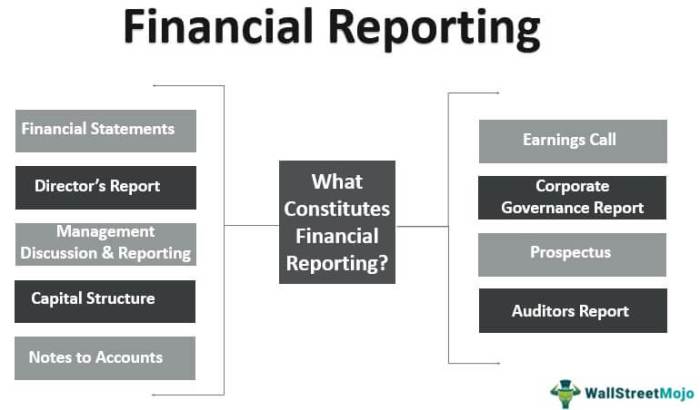
Effective data collection and input are fundamental to a robust financial reporting system. The chosen methods directly impact the accuracy, timeliness, and efficiency of the entire process. A well-designed system considers the various input methods available, balances automation with manual intervention where necessary, and incorporates rigorous validation and error handling.
Data input methods can be broadly categorized as manual, automated, and integrated. Manual data entry involves direct input by human operators, often from source documents. Automated methods utilize technology to capture and process data, minimizing human intervention. Integrated systems combine both manual and automated processes, leveraging the strengths of each approach.
Comparison of Data Input Methods
Manual data entry, while simple to implement initially, is prone to errors, slow, and labor-intensive. Automated methods, such as optical character recognition (OCR) for invoice processing or direct data feeds from bank accounts, significantly reduce errors and improve efficiency. However, they may require upfront investment in technology and integration. Integrated systems offer a balanced approach, automating routine tasks while allowing for manual intervention when needed, for example, for complex transactions requiring human judgment. A well-designed system often incorporates a combination of these methods to optimize efficiency and accuracy.
Data Validation and Error Handling
Robust data validation and error handling procedures are crucial for maintaining data integrity. These procedures should identify and correct or flag data errors before they propagate through the system and impact reporting. Validation rules can be implemented at the point of data entry, checking for data type, format, and range constraints. Error handling mechanisms should provide clear feedback to users, allowing them to correct errors immediately. For instance, a system could highlight invalid entries in red, provide descriptive error messages, or automatically reject transactions that fail validation checks. Regular audits and reconciliation procedures can further enhance data accuracy.
Data Cleansing and Accuracy
Data cleansing is a critical process for ensuring data accuracy. It involves identifying and correcting or removing inaccurate, incomplete, irrelevant, or duplicate data. This process can involve automated techniques, such as using algorithms to detect anomalies, and manual review by trained personnel. For example, a data cleansing process might involve identifying and correcting inconsistencies in customer addresses, standardizing date formats, or removing duplicate entries. Regular data cleansing ensures the data used for financial reporting is reliable and consistent. This improves the quality of reports and reduces the risk of misinterpretations.
Software and Technologies for Data Input and Management
Several software and technologies facilitate efficient data input and management. Enterprise Resource Planning (ERP) systems like SAP or Oracle provide integrated solutions for managing various aspects of a business, including financial data. Specialized accounting software packages offer features for data entry, validation, and reporting. Cloud-based solutions offer scalability and accessibility, while data warehousing technologies enable efficient storage and retrieval of large volumes of financial data. Database management systems (DBMS) such as MySQL or PostgreSQL are used to store and manage the data effectively. The selection of appropriate software depends on the specific needs and scale of the organization.
Processing and Reporting Procedures
Efficient processing and reporting procedures are crucial for a robust financial reporting system. These procedures ensure the accuracy, timeliness, and reliability of the financial information generated, ultimately supporting sound decision-making. A well-defined process minimizes errors and enhances the overall efficiency of the reporting cycle.
The generation of financial reports involves a series of interconnected steps, each contributing to the final output. These steps should be clearly defined and followed consistently to maintain data integrity and produce reliable reports.
Report Generation Steps
A systematic approach to report generation is essential for accuracy and efficiency. Following a structured process ensures that all necessary data is processed correctly and that the final reports are complete and reliable.
- Data Validation and Cleansing: Before processing, all collected data undergoes a thorough validation and cleansing process. This involves checking for inconsistencies, errors, and missing values. Data cleansing techniques, such as outlier detection and data imputation, are employed to ensure data quality.
- Data Transformation: Raw data is transformed into a usable format for reporting. This might involve calculations, aggregations, and adjustments based on accounting principles. For example, converting raw transaction data into summarized account balances.
- Report Design and Formatting: Reports are designed to clearly present the financial information. This includes selecting appropriate charts, graphs, and tables, ensuring readability and understandability. The format should align with the needs of the intended audience and comply with any relevant accounting standards.
- Report Generation and Output: Using specialized software or programming tools, the processed data is used to generate the financial reports. These reports can be exported in various formats (e.g., PDF, Excel, CSV) to meet specific requirements.
- Report Review and Approval: Before distribution, generated reports undergo a review process to ensure accuracy and completeness. This often involves multiple levels of approval, depending on the report’s significance and the organization’s internal controls.
- Report Distribution and Archiving: Once approved, reports are distributed to the relevant stakeholders. A secure archiving system ensures that reports are readily accessible for future reference and audit purposes. Version control is crucial to maintain the integrity of the reporting process.
Data Security and Access Control
Protecting sensitive financial data is paramount. Implementing robust security measures and access controls is crucial to maintain data integrity and prevent unauthorized access or modification.
Strong password policies, multi-factor authentication, and encryption techniques should be employed to safeguard data. Access to the system and individual reports should be granted based on the principle of least privilege, ensuring that only authorized personnel can access specific data and functionalities. Regular security audits and vulnerability assessments are also essential to identify and address potential security risks.
Remember to click How Financial Statement Manipulation Impacts Global Market Trust to understand more comprehensive aspects of the How Financial Statement Manipulation Impacts Global Market Trust topic.
Automating Routine Reporting Tasks
Automating routine reporting tasks significantly improves efficiency and reduces the risk of human error. Many reporting systems allow for the scheduling of automated report generation, distribution, and archiving. This frees up valuable time for more strategic tasks, such as financial analysis and decision-making.
For example, monthly balance sheets and income statements can be automatically generated and emailed to relevant stakeholders on a predetermined schedule. Automated reconciliation processes can also be implemented to streamline the reconciliation of bank statements and other financial accounts. This automation can be achieved through scripting, using tools like Python or R, or through the built-in functionalities of financial reporting software.
Report Design and Presentation: How To Develop An Effective Financial Reporting System

Effective financial reporting isn’t just about accurate data; it’s about presenting that data in a clear, concise, and easily understandable manner. The design and presentation of your reports significantly impact their usefulness and the decisions made based on them. A well-designed report facilitates informed decision-making, while a poorly designed one can lead to misinterpretations and costly errors.
Types of Financial Reports and Key Elements
Financial reports come in various forms, each serving a specific purpose. Three fundamental reports are the balance sheet, the income statement, and the cash flow statement. These reports provide a comprehensive overview of a company’s financial health. Below are examples illustrating key elements presented in a tabular format.
| Report Type | Key Element 1 | Key Element 2 | Key Element 3 |
|---|---|---|---|
| Balance Sheet | Assets (e.g., Cash, Accounts Receivable, Inventory) | Liabilities (e.g., Accounts Payable, Loans) | Equity (e.g., Retained Earnings, Common Stock) |
| Income Statement | Revenue (e.g., Sales, Service Revenue) | Expenses (e.g., Cost of Goods Sold, Operating Expenses) | Net Income (Revenue – Expenses) |
| Cash Flow Statement | Operating Activities (e.g., Cash from Sales, Payments to Suppliers) | Investing Activities (e.g., Purchase of Equipment, Sale of Investments) | Financing Activities (e.g., Issuance of Stock, Repayment of Debt) |
Clear and Concise Report Design for Effective Communication
Clarity and conciseness are paramount in financial report design. Ambiguity can lead to misinterpretations and incorrect conclusions. Reports should be easy to navigate, with clear headings, subheadings, and a logical flow of information. Using consistent formatting, such as fonts and spacing, enhances readability. Furthermore, avoiding technical jargon whenever possible makes the information accessible to a wider audience. For example, instead of using “depreciation expense,” a simpler term like “wear and tear cost” might be more easily understood by a non-financial audience.
Using Visualizations to Enhance Report Understanding
Visualizations, such as charts and graphs, are powerful tools for conveying complex financial data in a readily digestible format. For instance, a line graph can effectively illustrate revenue trends over time, while a bar chart can compare different expense categories. Pie charts can show the proportion of different assets or liabilities. Choosing the appropriate visualization method depends on the type of data and the message being conveyed. Overuse of visualizations, however, can be counterproductive. It is crucial to select only the visualizations that are truly necessary and informative.
Best Practices for Presenting Financial Information to Different Audiences
Tailoring the presentation of financial information to the audience is crucial. A report for senior management might require detailed financial analysis and projections, while a report for a board of directors may need a more concise summary highlighting key performance indicators (KPIs). Similarly, reports for external stakeholders, such as investors or creditors, will require adherence to specific accounting standards and disclosure requirements. Using plain language, avoiding overly technical terminology, and providing context for the data will ensure effective communication across all audiences. For instance, a presentation to investors might emphasize profitability and growth, while a presentation to employees might focus on job security and company performance.
System Security and Control
A robust financial reporting system requires comprehensive security measures to protect data integrity and prevent fraudulent activities. This involves implementing various controls to ensure accuracy, reliability, and the confidentiality of financial information. Strong security not only safeguards the organization’s financial assets but also maintains its reputation and fosters trust with stakeholders.
Data Integrity and Fraud Prevention
Maintaining the accuracy and completeness of financial data is paramount. Several measures can be implemented to achieve this. These include employing strong password policies, restricting access based on roles and responsibilities (role-based access control or RBAC), and regularly reviewing user access permissions. Furthermore, implementing data encryption both in transit and at rest protects sensitive financial information from unauthorized access. Regular data validation checks, including automated cross-referencing and plausibility checks, help detect inconsistencies and potential errors. Finally, implementing a robust audit trail allows for tracking all changes and transactions made within the system, enabling detection and investigation of any suspicious activity. The use of checksums or hash functions can further verify data integrity by ensuring data hasn’t been tampered with.
System Audits and Backups
Regular system audits are crucial for identifying vulnerabilities and ensuring the system’s continued effectiveness. These audits should be conducted by independent internal or external auditors who can assess the system’s controls, identify weaknesses, and recommend improvements. Audits should cover areas such as access control, data validation, and the overall security posture of the system. Simultaneously, regular backups of the financial data are essential to protect against data loss due to hardware failure, software glitches, or malicious attacks. A comprehensive backup strategy should include both on-site and off-site backups, with regular testing to ensure data recoverability. The frequency of backups should be determined based on the criticality of the data and the acceptable level of data loss. For example, a daily backup might be appropriate for critical financial data, while weekly backups may suffice for less critical information.
Internal Controls
Internal controls are the processes and procedures designed to ensure the accuracy and reliability of financial reporting. These controls span various aspects of the financial reporting process, from data input and processing to report generation and distribution. Strong internal controls include segregation of duties, which prevents any single individual from having excessive control over financial transactions. Authorization controls ensure that only authorized personnel can initiate and approve transactions. Reconciliation processes, such as comparing bank statements to internal records, help detect discrepancies and errors. Regular reviews and monitoring of financial data and transactions by management also play a critical role in maintaining accuracy and identifying potential issues. For example, comparing budgeted versus actual expenses allows for early detection of potential variances.
Security Protocols and Access Control Mechanisms
Several security protocols and access control mechanisms can enhance the security of a financial reporting system. These include:
- Firewalls: These act as barriers between the system and external networks, preventing unauthorized access.
- Intrusion Detection/Prevention Systems (IDS/IPS): These systems monitor network traffic for malicious activity and can block or alert on suspicious behavior.
- Multi-factor Authentication (MFA): This requires users to provide multiple forms of authentication, such as a password and a one-time code, before gaining access to the system.
- Data Loss Prevention (DLP) tools: These tools monitor and prevent sensitive data from leaving the organization’s network without authorization.
- Role-Based Access Control (RBAC): This assigns access rights based on an individual’s role within the organization, ensuring that users only have access to the information necessary for their job function.
Implementing these measures creates a layered security approach, significantly reducing the risk of unauthorized access, data breaches, and fraud. For instance, a combination of MFA and RBAC can significantly enhance the security of a system, as it requires multiple authentication steps and restricts access to sensitive data based on roles.
System Maintenance and Upgrades
A robust financial reporting system requires ongoing maintenance and timely upgrades to ensure accuracy, efficiency, and compliance. Neglecting these aspects can lead to data inconsistencies, system failures, and potential regulatory issues. A well-defined maintenance plan is crucial for the long-term health and effectiveness of the system.
Regular maintenance and updates are vital for optimizing system performance and preventing potential problems. This includes proactive measures to address vulnerabilities, improve data integrity, and enhance user experience. Furthermore, staying abreast of evolving accounting standards and technological advancements is essential for maintaining a compliant and efficient system.
Regular System Maintenance and Updates
A comprehensive maintenance plan should include scheduled backups, software updates, security patches, and routine system checks. Backups should be performed regularly, ideally daily, and stored securely offsite to protect against data loss. Software updates should be applied promptly to address bugs and security vulnerabilities. Regular system checks should include verifying data integrity, checking for errors, and assessing overall system performance. For example, a monthly check could involve running system diagnostics and reviewing log files to identify any potential issues. Quarterly reviews might encompass a more in-depth analysis of system performance and user feedback. Annual reviews could focus on larger-scale upgrades and potential system overhauls.
Identifying and Resolving System Issues
A clear process for identifying and resolving system issues is critical for minimizing downtime and maintaining data integrity. This process should involve establishing a system for reporting issues, prioritizing them based on severity, and assigning responsibility for resolution. A ticketing system, for instance, can be used to track reported problems, monitor their progress, and ensure timely resolution. Regular monitoring of system logs can proactively identify potential issues before they escalate into major problems. Thorough documentation of troubleshooting steps is essential for efficient problem-solving and future reference. For example, a detailed log of the steps taken to resolve a specific error can prevent similar issues from recurring.
Staying Current with Accounting Standards and Technology Advancements
The accounting landscape is constantly evolving, with new standards and regulations being introduced regularly. Similarly, technological advancements offer opportunities to improve the efficiency and effectiveness of financial reporting systems. Staying current with these changes is crucial for ensuring compliance and leveraging the latest technologies. This involves regularly reviewing updates to accounting standards, attending industry conferences and workshops, and actively seeking out training opportunities on new technologies. For instance, adopting cloud-based solutions can offer improved scalability, accessibility, and data security. Implementing advanced analytics tools can provide deeper insights into financial data and enhance decision-making.
User Training and Support
Effective user training is essential for maximizing the benefits of the financial reporting system. Training should cover all aspects of the system, from data entry and processing to report generation and interpretation. Comprehensive training materials, including manuals, tutorials, and online resources, should be readily available. Regular refresher courses can help maintain user proficiency and address any emerging questions or concerns. Ongoing support should be provided to users to address any technical difficulties or questions they may encounter. This can involve providing access to help desk support, online forums, or dedicated training sessions. For example, a comprehensive training program might include a combination of classroom instruction, hands-on exercises, and online modules. Providing ongoing support through FAQs, online tutorials, and a dedicated help desk ensures users can effectively utilize the system.
Integration with Other Systems

Integrating your financial reporting system with other business systems offers significant advantages, streamlining operations and improving data accuracy. A well-integrated system provides a holistic view of the business, facilitating better decision-making and enhancing overall efficiency. This section will explore the benefits, methods, challenges, and examples of successful integrations.
Effective integration enhances data consistency and reduces the risk of errors arising from manual data entry or discrepancies between different systems. By connecting systems like Enterprise Resource Planning (ERP) and Customer Relationship Management (CRM) software, businesses can automate data flows, eliminating the need for time-consuming manual reconciliation and reducing the potential for human error. This leads to more reliable financial reporting and a clearer picture of the company’s financial health.
Benefits of System Integration
Integrating your financial reporting system with other core business systems, such as ERP and CRM, offers several key advantages. These improvements lead to better data management and more informed decision-making. For example, integrating with an ERP system allows for automatic transfer of transactional data, eliminating manual data entry and reducing errors. Similarly, CRM integration provides insights into customer behavior and sales performance, which can be valuable in financial forecasting and analysis. The overall effect is a more efficient and accurate financial reporting process.
Ensuring Data Consistency Across Systems, How to Develop an Effective Financial Reporting System
Maintaining data consistency across integrated systems requires careful planning and implementation. Standardization of data formats and definitions is crucial. Data mapping, a process that links data elements across different systems, is essential for ensuring that data is interpreted consistently. Regular data validation and reconciliation procedures should be in place to detect and correct inconsistencies. Employing robust data governance policies and procedures further enhances data quality and consistency. For example, a well-defined data dictionary can prevent ambiguity in data definitions across systems.
Challenges in System Integration and Mitigation Strategies
Integrating different systems can present various challenges. Differences in data structures and formats between systems can create significant hurdles. Compatibility issues between different software platforms and versions may also arise. Security concerns and data migration complexities need careful consideration. To overcome these, organizations should invest in robust integration tools and employ skilled professionals with expertise in data integration. Thorough planning, including a detailed assessment of system compatibility and data migration strategies, is essential. Phased implementation, starting with a pilot project, can minimize risks and allow for iterative improvements.
Examples of Successful System Integrations
Many companies have successfully integrated their financial reporting systems with other business systems, realizing significant improvements in efficiency and accuracy. For example, a large retail company integrated its point-of-sale (POS) system with its ERP and financial reporting systems, enabling real-time sales data updates and more accurate inventory management. This resulted in more accurate financial reporting and improved inventory control. Another example involves a manufacturing company that integrated its ERP and CRM systems with its financial reporting system, leading to better visibility into sales performance, customer profitability, and improved financial forecasting. These successful implementations demonstrate the transformative potential of integrated systems.
Epilogue
Creating an effective financial reporting system is a journey, not a destination. By following the steps Artikeld, organizations can build a system that provides accurate, timely, and insightful financial information. Remember that ongoing maintenance, adaptation to evolving business needs, and adherence to best practices are crucial for long-term success. Investing in a well-designed system will ultimately lead to better financial management, informed decision-making, and enhanced organizational performance.
FAQ Compilation
What are the common pitfalls to avoid when developing a financial reporting system?
Common pitfalls include neglecting data validation, insufficient security measures, poor report design leading to misinterpretations, and a lack of integration with other business systems. Failing to adequately train users is also a frequent issue.
How often should the financial reporting system be audited?
The frequency of audits depends on factors like company size, industry regulations, and internal risk assessment. However, regular audits, at least annually, are recommended to ensure data integrity and compliance.
What software options are available for building a financial reporting system?
Many options exist, ranging from spreadsheet software like Excel to specialized accounting software packages and cloud-based solutions. The best choice depends on budget, technical expertise, and specific business needs.
How can I ensure my financial reporting system complies with relevant regulations?
Staying current with relevant accounting standards (like GAAP or IFRS) and ensuring your system’s design and processes align with these standards is crucial. Consider consulting with accounting professionals to ensure compliance.


:max_bytes(150000):strip_icc()/accounting-valuation.asp_Final-f441df548f6444ca9db23e01b7ea9efe.png?w=700)